

Office phone booths range from compact single-person pods for private calls to larger enclosed spaces for small team meetings. Choosing the right type depends on your team size, work patterns, available floor space, and acoustic requirements — especially whether a booth meets ISO 23351-1 standards for verified speech privacy.
Open offices were designed to support collaboration, but for many teams they have created ongoing problems with noise, distraction, and lack of privacy. As a result, phone booths and acoustic pods have become one of the most practical ways to add quiet, enclosed space without renovation.
This guide explains the main types of office phone booths, how they differ, what acoustic claims to look for, and how to decide which option best fits your workplace.
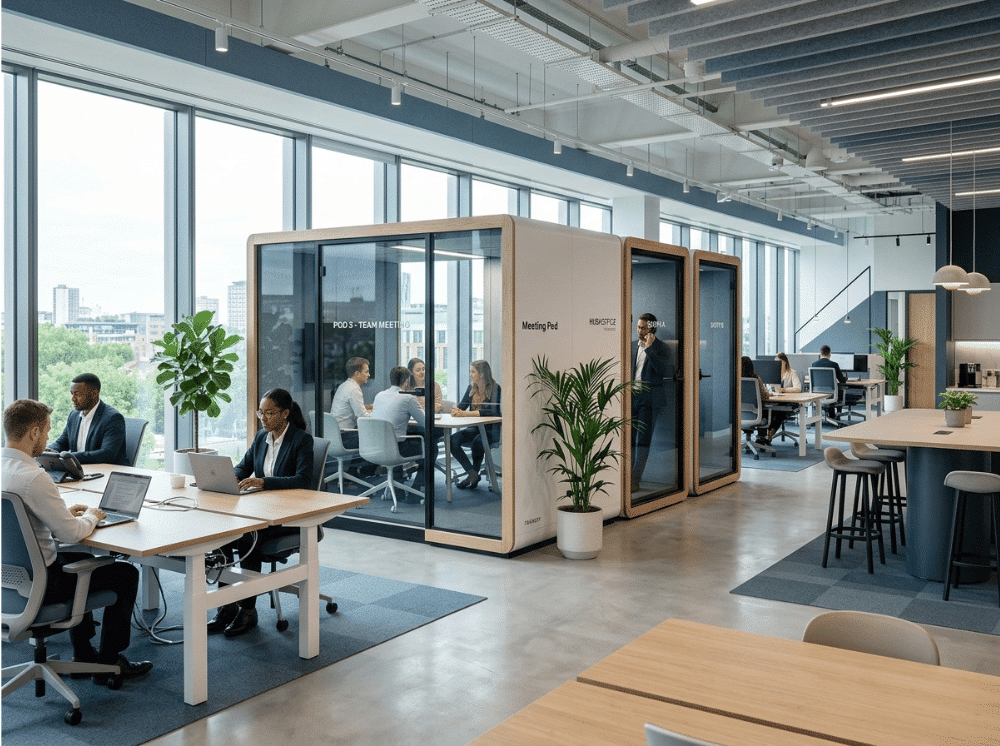
What Is an Office Phone Booth — and How Does the Terminology Work?
Before comparing products, it helps to get the terminology straight. The market uses several overlapping terms, often interchangeably:
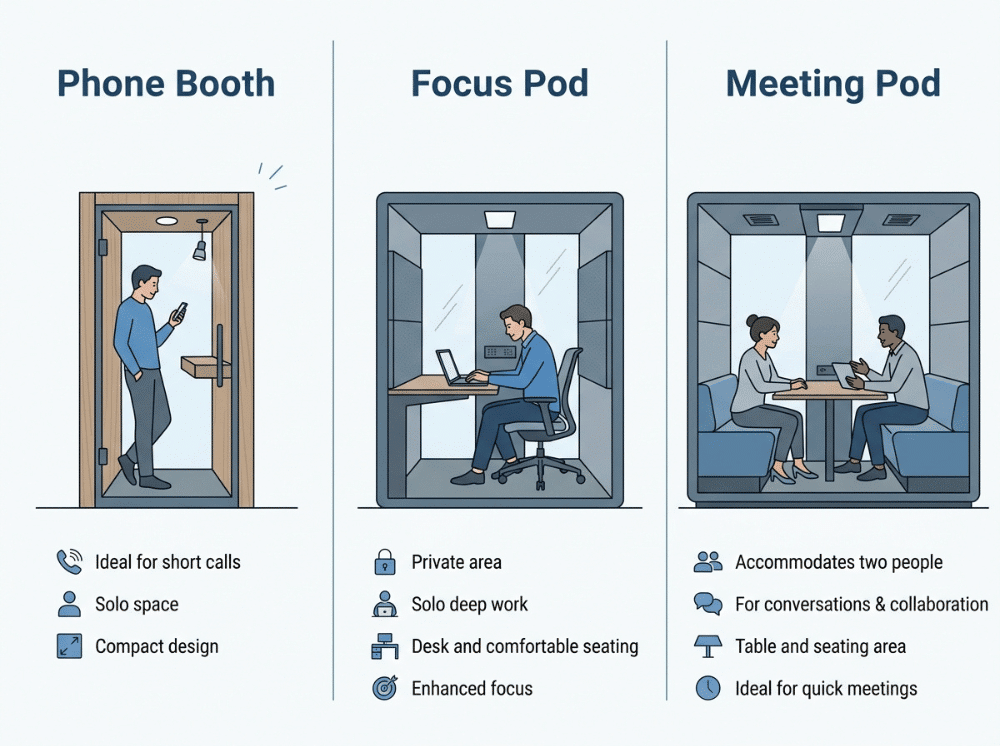
- Office phone booth: The broadest term. Refers to any freestanding, acoustically insulated enclosure designed to provide privacy in an open office. Can range from one to six or more people.
- Focus pod: Usually a single-person enclosure optimized for deep, uninterrupted work — not necessarily calls. May or may not have built-in power or screens.
- Meeting pod: A larger enclosure designed for two or more people. Used for 1:1 conversations, team huddles, client calls, or small group sessions.
- Privacy pod: A general term that emphasizes acoustic isolation over any specific use case. Often used to describe both single-person and multi-person enclosures.
For practical purchasing purposes, the key distinction is capacity and primary use case. A single-person booth and a six-person conference pod serve fundamentally different roles, have different footprints and price points, and belong in different locations within your floor plan.
Why Private Booths Matter in Open Offices
Noise isn’t just uncomfortable — it’s a measurable drag on output. Research published in the Research Trends Journal (2025) links acoustic interventions to 20–30% improvements in focus and task accuracy compared to untreated spaces. That figure applies to any acoustic solution, including designated quiet zones and sound-absorbing materials, but phone booths remain the most immediately deployable option for most offices.
Beyond productivity, there are three additional drivers pushing organizations toward acoustic pods:
Speech privacy and compliance. Many roles involve confidential conversations — HR interviews, legal discussions, financial advice, and client consultations. In open offices, drywall alone rarely provides adequate speech isolation for sensitive discussions. Acoustic pods that meet verified speech privacy standards add a measurable layer of protection.
Meeting room saturation. In most offices, traditional meeting rooms are chronically overbooked. One or two people routinely occupy a room built for eight, while others can’t find a quiet space for a 15-minute call. Phone booths act as overflow capacity, freeing larger rooms for their intended purpose.
Return-to-office friction. Employees who work from home are accustomed to controlling their acoustic environment. Office experiences that score roughly 10 points lower than remote work on the Leesman Index (2024–2025) suggest that many workplaces still struggle to match the focused, quiet conditions people can create at home. Acoustic pods help close that gap.
The 5 Main Types of Office Phone Booths
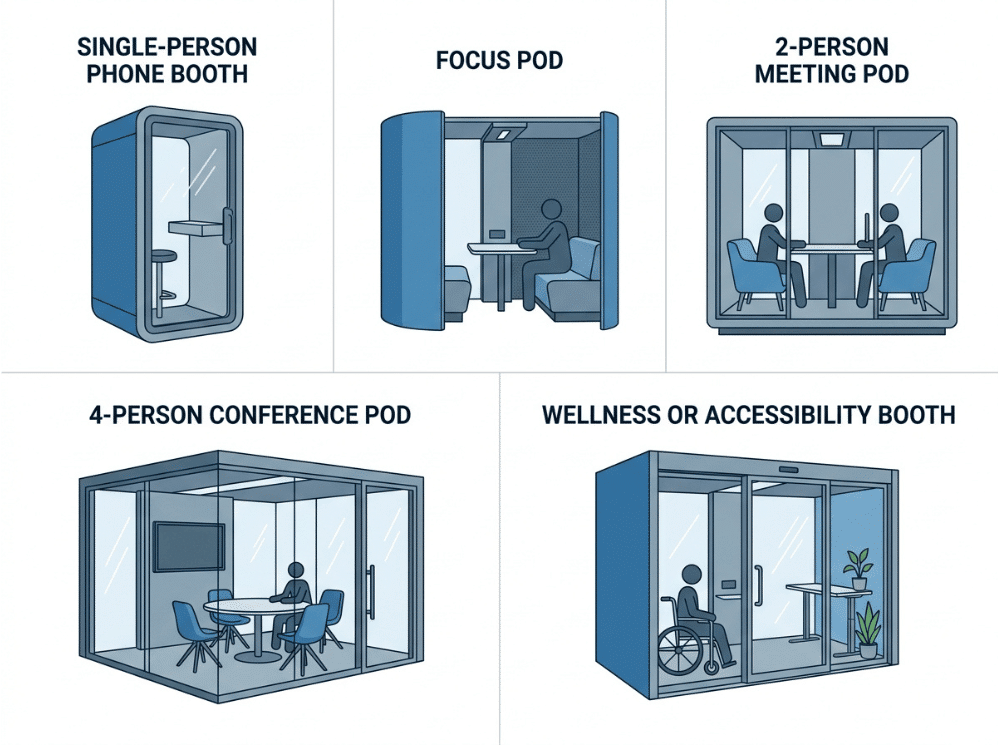
1. Single-Person Telephone Booths
The original office phone booth format. Compact, typically designed for one seated occupant, and optimized for private calls, video conferencing, and short focused-work sessions.
Best for: Private calls, video meetings, quick, focused tasks, HR- or compliance-sensitive conversations where only one person needs to be included.
Recommended session length: 30–60 minutes. Single-person booths are not designed for extended desk-replacement use — most include ventilation systems, but air circulation in compact spaces is limited compared to larger enclosures.
Key considerations: Look for ISO 23351-1 acoustic certification (more on this below), built-in ventilation, adequate interior lighting for video calls, and power outlets with USB charging. The OMS Office 1-Person Office Phone Booth installs in approximately 30 minutes without tools and achieves a certified DSA of 31.4 dB under ISO 23351-1.
Footprint: Smallest of all booth types — typically suitable for any open office area with sufficient clearance around the door swing.
2. Focus Pods for Deep Work
Focus pods share the same general form as single-person telephone booths but are configured specifically for sustained cognitive work — writing, analysis, coding, reading — rather than calls. They may feature a wider work surface, better overhead lighting, and fewer call-specific features, such as camera-facing task lighting.
In practice, many single-person booths serve both functions. The distinction is mostly in the interior configuration. If your team primarily needs quiet for focused tasks rather than calls, look for a booth with a full-width desk surface, eye-level lighting, and USB-C charging rather than one optimized for a webcam setup.
Best for: Individual deep work, writing, analysis, and uninterrupted coding sessions.
Key consideration: If your organization allows extended use (over 90 minutes), prioritize booths with an active ventilation system over those with passive circulation. CO₂ build-up in small enclosures becomes noticeable within an hour without effective air exchange.
3. Two-Person Meeting Pods
Two-person pods occupy the middle ground between a single telephone booth and a full meeting room. They’re designed for paired work: 1:1 check-ins, performance reviews, job interviews, mentoring sessions, and confidential bilateral conversations.
The OMS Office 2-Person Office Phone Booth adds smart sensor lighting and active ventilation to the same demountable, tool-free platform — useful for HR departments, client-facing teams, and any environment where paired private conversations happen frequently.
Best for: Interviews, 1:1 meetings, mentoring, bilateral client calls, confidential discussions involving two participants.
Key consideration: Two-person pods are among the highest-utilization enclosures in most offices because so many workplace conversations are inherently bilateral. Many facilities managers underestimate the demand for this size and order too few.
4. Large Team Conference Pods (4–6 Person)
These are the enclosures that most closely approximate the functionality of a traditional meeting room, without the construction, permits, or permanence. They accommodate small- to medium-group discussions, team huddles, client presentations, and multi-party video calls.
OMS Office offers two options at this scale:
- 4-Person Meeting Pod: Designed for small-team discussions, remote video calls, and quick project huddles. Installs in approximately 60 minutes. Upgradeable ventilation system.
- 6-Person Meeting Pod: The largest format in the range, suited to medium team meetings, client presentations, and conference calls. Recommended for teams that regularly hold structured group sessions but lack reliable access to a dedicated meeting room. Also installs without construction in approximately 75 minutes.
Best for: Team stand-ups, client presentations, structured project meetings, multi-party video conferences, and brainstorming sessions.
Key consideration: Larger pods require significantly more floor space and slightly longer installation time. At this size, ventilation quality becomes critical — look for upgradeable active ventilation and check whether the system can handle the thermal load of multiple occupants in extended sessions.
5. Wellness and Accessibility-Focused Booths
This is an emerging but increasingly important product category. Wellness-oriented enclosures may feature softer lighting options, biophilic interior materials, reduced sensory stimulation for neurodiverse users, or reclined seating configurations for rest and recovery.
Accessibility-focused designs address usability for wheelchair users and people with mobility limitations — specifically, wide access doors, low-threshold entries, and accessible interior layouts. In the United States, ADA compliance requirements apply differently to fixed structures versus movable furniture, and phone booths generally fall into the latter category. That said, confirming your specific configuration with your facilities manager and a qualified accessibility consultant before procurement is advisable.
OMS Office booths can be configured to meet ADA compliance standards upon request. Contact the OMS Office team for specifications and to discuss requirements for your project.
Best for: Quiet rooms, neurodiversity accommodation, privacy for sensitive personal situations, organizations with accessibility-focused workplace design mandates.
Quick Comparison: Office Booth Types at a Glance
|
Booth Type |
Capacity |
Primary Use |
Session Length |
Acoustic Priority |
|---|---|---|---|---|
|
Single-person phone booth |
1 |
Private calls, video meetings |
30–60 min |
High |
|
Focus pod |
1 |
Deep work, extended concentration |
60–90 min |
High |
|
2-person meeting pod |
2 |
1:1 meetings, interviews |
30–60 min |
High |
|
4-person conference pod |
2–4 |
Small team meetings, huddles |
60–90 min |
High |
|
6-person conference pod |
4–6 |
Team meetings, presentations |
60–90 min |
High |
|
Wellness/accessibility booth |
1–2 |
Quiet rooms, accessibility use |
Varies |
Medium–High |
All OMS Office booth types carry ISO 23351-1 acoustic certification and a 5-year structural warranty across the full range.
Understanding ISO 23351-1: The Acoustic Standard That Actually Matters
If there is one technical specification worth understanding before you buy any office phone booth, it is ISO 23351-1. This international standard, published by the International Organization for Standardization, measures the “speech level reduction” of furniture enclosures and pods using a single, standardized methodology — allowing objective comparisons across manufacturers.
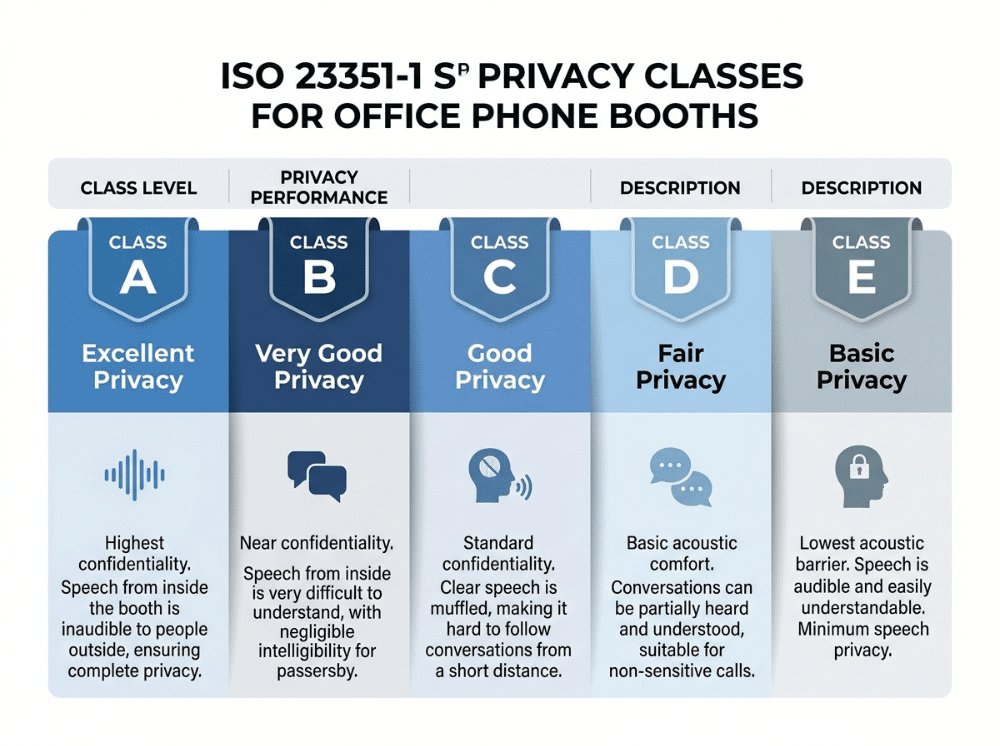
The classification system works as follows:
|
ISO 23351-1 Class |
Speech Level Reduction |
Speech Privacy |
|---|---|---|
|
A |
30–33 dB |
Guaranteed |
|
B |
25–30 dB |
Guaranteed |
|
C |
20–25 dB |
Depends on background noise |
|
D |
15–20 dB |
Depends on background noise |
|
E |
Under 15 dB |
Not guaranteed |
For most standard office environments, Class B (25–30 dB) provides sufficient speech privacy. Class A (30–33 dB) offers an additional margin for quieter office settings — typically those with ambient noise levels below 35 dB — and for organizations with stricter confidentiality requirements.
A critical caveat: only compare decibel ratings between suppliers that obtained their ISO 23351-1 rating from an accredited external testing facility. In-house acoustic testing is not standardized and can produce inflated or unreliable figures. Ask suppliers for their SGS or equivalent third-party test certification before making a decision.
OMS Office booths achieve a certified DSA of 31.4 dB under ISO 23351-1 — placing them in the Class A range — validated through SGS acoustic testing.
6 Buying Factors to Evaluate Before You Commit
1. Floor Space and Door Clearance
Map your floor plan before selecting booth sizes. Single-person booths require the smallest footprint, but all booth types need adequate clearance around the door swing. Avoid positioning booths where the door conflicts with major circulation routes.
2. Acoustic Certification
Request ISO 23351-1 certification with third-party test validation. Reject any supplier that offers decibel claims without a verifiable external test source.
3. Ventilation Quality
Ventilation is one of the most underestimated specifications in the market. Short sessions (under 30 minutes) in small enclosures are manageable with passive ventilation. For regular sessions of 45 minutes or more, or for larger pods with multiple occupants, active mechanical ventilation with an adequate air exchange rate is not optional — it is a health and comfort requirement.
4. Power and Connectivity
Verify that the booth includes the outlet configuration your team needs. Standard setups typically include 220V power and USB-A/USB-C charging. For video call use, consider whether built-in cable management and screen mounting options are available.
5. Portability and Demountability
A demountable, tool-free design means you can relocate the booth if your office layout changes — a significant advantage over built-in rooms. Confirm that your chosen model can be reassembled without specialized tools or additional materials after relocation.
6. Fire Code and Permits
In most regions, freestanding office phone booths are classified as movable furniture rather than permanent structures, which typically means they do not require building permits or fire code approvals beyond standard furniture placement requirements. Confirm this with your building manager and local authority before purchasing, as requirements vary by location and building classification.
Phone Booths vs. Built Rooms: A Practical Cost Comparison
The financial case for acoustic pods over traditional renovation is straightforward. Modular pods require no construction, generate no downtime, and can be relocated or reconfigured as your team evolves. Traditional built rooms involve architect fees, construction labor, extended downtime, HVAC integration, and, in many cases, building permits.
The flexibility dividend is equally significant. A built room is permanent — any future change requires another round of construction. A pod is an asset: relocatable, reusable, and in most cases resaleable. For growing businesses or teams in leased spaces, that flexibility is particularly valuable.
From a tax treatment perspective, movable furniture assets may qualify for different depreciation treatment than permanent leasehold improvements in some jurisdictions. Confirm the appropriate classification with your accountant or financial advisor, as rules vary by country and entity type.
How Many Booths Does Your Office Actually Need?
A common starting guideline is one phone booth per 10–15 employees in open office environments (OMS Office FAQ; Ethosource, 2024). The right number for your organization depends on:
- Work pattern: Teams with high volumes of client calls or external meetings need more single-person booths. Teams doing primarily deep individual work may benefit from more focus pods.
- Existing meeting infrastructure: If your office is well-supplied with meeting rooms, you may need fewer large pods. If meeting rooms are chronically overbooked, additional 4-person pods will reduce bottlenecks.
- Growth trajectory: Modular booths are addable. Start with what your current utilization justifies, then scale as headcount grows.
A practical audit approach: track meeting room bookings and note how often rooms seat fewer than their stated capacity. Track how often employees resort to stairwells, corridors, or unused areas for private calls. Both signals indicate unmet demand for acoustic enclosures.
Red Flags to Watch for When Evaluating Suppliers
Not all phone booth manufacturers are equal. Watch for:
- Decibel claims without ISO 23351-1 third-party certification are almost certainly inflated
- No ventilation system or passive-only ventilation in booths marketed for extended sessions
- No structural warranty or warranties shorter than three years on core components
- Proprietary installation systems that require specialized tools or the supplier’s technicians for relocation
- No local stock or distribution — extended lead times can significantly delay workspace improvements
Your Next Step
Selecting the right mix of office phone booths is a workspace planning decision, not just a purchasing decision. The most effective deployments combine booth types — single-person enclosures for calls and focus work, two-person pods for 1:1 conversations, and larger team pods as meeting room supplements — matched to the actual work patterns of the team using them.
OMS Office provides a full range of ISO 23351-1-certified acoustic enclosures, from the compact 1-person booth to the 6-person meeting pod, all built on a demountable platform with a 5-year structural warranty. The full product range is available at omsoffice.com/office-phone-booths.
For project-specific guidance on quantities, layouts, or custom configurations, contact the OMS Office team for a detailed quote.
Frequently Asked Questions
What is the difference between an office phone booth and a focus pod?
A phone booth is optimized for voice and video calls, with call-specific lighting and cable management. A focus pod is configured for sustained cognitive work — with a wider desk surface, eye-level lighting, and fewer call-centric features. In practice, many single-person booths serve both functions, and the terms are often used interchangeably in the market.
Are office phone booths actually soundproof?
No enclosure provides 100% acoustic isolation, and any supplier claiming otherwise is overstating their product’s performance. High-quality office phone booths achieve certified speech privacy through multi-layered acoustic construction. OMS Office booths achieve DSA 31.4 dB under ISO 23351-1 — a Class A rating — meaning conversations inside are not intelligible to people outside in typical office environments.
How many office phone booths does an open office need?
A commonly used starting guideline is one phone booth per 10–15 employees. The right number depends on your work patterns, call volume, available floor space, and existing meeting infrastructure. An audit of how existing meeting rooms are used will reveal the most accurate demand signal.
Do office phone booths require a building permit?
In most regions, freestanding phone booths are classified as movable furniture and do not require building permits. Confirm this with your building manager and local planning authority before installation, as rules vary by location, building type, and national or regional regulation.
Can office phone booths be relocated after installation?
Yes, provided they are designed with a demountable structure. OMS Office booths use a tool-free modular design that allows disassembly, relocation, and reassembly without drilling, construction, or specialized tools.
What should I look for in a booth used primarily for video calls?
The most important features for video call use are: ISO 23351-1 certified acoustic isolation for clear audio, even interior lighting positioned to illuminate the user’s face on camera, effective ventilation for extended sessions, and built-in power outlets with USB charging. OMS Office booths are purpose-built to include all of these.
How do office phone booths handle ventilation?
All OMS Office phone booths include a built-in intelligent ventilation system that maintains fresh air circulation without requiring external ducting. Larger pod models (4-person and 6-person) support an upgradeable active ventilation system for higher-occupancy or extended-duration use.
Are office phone booths ADA-compliant?
Accessibility compliance depends on the specific configuration and applicable local standards. OMS Office booths can be configured to meet ADA compliance standards upon request. Confirm requirements with your facilities manager and an accessibility consultant before procurement.
Can office phone booths be depreciated differently from built rooms?
In some jurisdictions, movable furniture assets depreciate differently from permanent leasehold improvements, which may offer a favorable tax position. Rules vary significantly by country, entity type, and asset classification. Confirm the appropriate treatment with a qualified accountant or financial advisor.
How long does installation take?
OMS Office booth installation times are approximately: 30 minutes for a 1-person booth, 45 minutes for a 2-person booth, 60 minutes for a 4-person pod, and 75 minutes for a 6-person pod. No specialist tools or construction are required.