

Office phone booths are self-contained, prefabricated acoustic enclosures designed for open-plan offices. They give employees a quiet, private space for calls, focused work, and confidential conversations — without the cost or disruption of permanent construction. The right booth depends on your team size, acoustic needs, and how much space you have to work with.
Open-plan offices were built around one idea: collaboration. The reality? Most employees spend large portions of their day trying to escape the noise. According to ActivTrak’s 2026 State of the Workplace Report, the average focused work session now lasts just 13 minutes and 7 seconds — and research by Gloria Mark at UC Irvine shows it takes 23 minutes and 15 seconds to fully regain deep concentration after a single interruption.
That math is brutal. One distraction costs nearly half an hour of productive output.
Noise is the primary culprit. Research by Resonics, cited by workplace acoustics specialists, found that office noise distractions account for a 66% reduction in productivity. For facility managers, HR directors, and founders trying to get the most from their teams, that figure demands a practical response.
Office phone booths are the response. This guide covers everything you need to make a confident buying decision — from acoustic standards and ventilation specs to pod types, use cases, fire safety considerations, and how many booths your office actually needs.
What Is an Office Phone Booth?
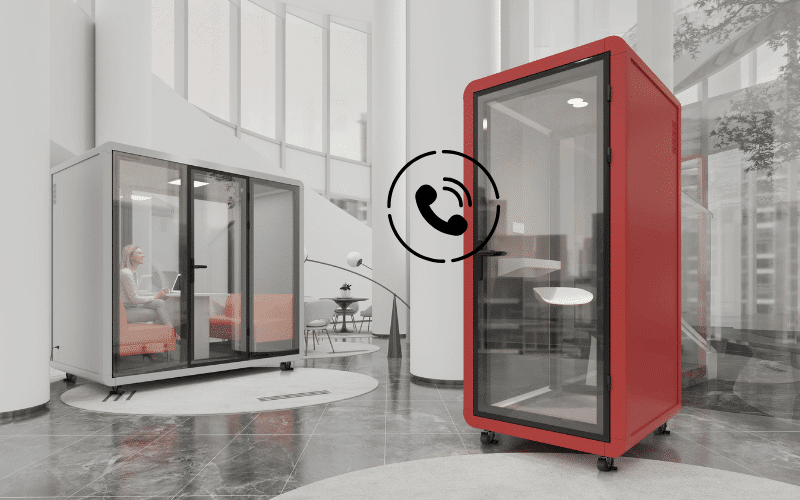
An office phone booth — also called an acoustic office pod, soundproof office booth, or office privacy booth — is a prefabricated, self-contained enclosure that fits inside an open-plan office. Unlike a traditional conference room, it requires no building permits, no structural modifications, and no construction timeline measured in weeks.
The core components of a quality acoustic office pod are:
- Acoustic-grade panels that block and absorb sound through layered material construction
- Active ventilation that circulates fresh air without creating a sound leakage path
- Integrated power including standard outlets, USB-A, and USB-C ports
- A sealed door with compression or magnetic gaskets that close off the interior acoustically
- Interior lighting and surfaces designed for comfortable, extended use
The key distinction between an office phone booth and a traditional meeting room lies in their classification. Pods are office furniture — not permanent fixtures. That means they can be repositioned, relocated to a new building, or reconfigured as your team grows. They also qualify as capital allowances under the UK’s Annual Investment Allowance, which has real implications for how they appear on a balance sheet.
Typical users: Facility managers and workplace designers specifying acoustic solutions for open-plan floors; HR directors needing private spaces for sensitive conversations; founders of scale-ups whose teams have outgrown their meeting rooms; and architects working on hybrid-ready office fitouts.
Core Categories of Acoustic Office Pods
Not every booth solves the same problem. The right choice depends on how many people will use it at once, what they’ll be doing inside, and what the ambient noise conditions are on your floor.
Single-Person Phone Booths
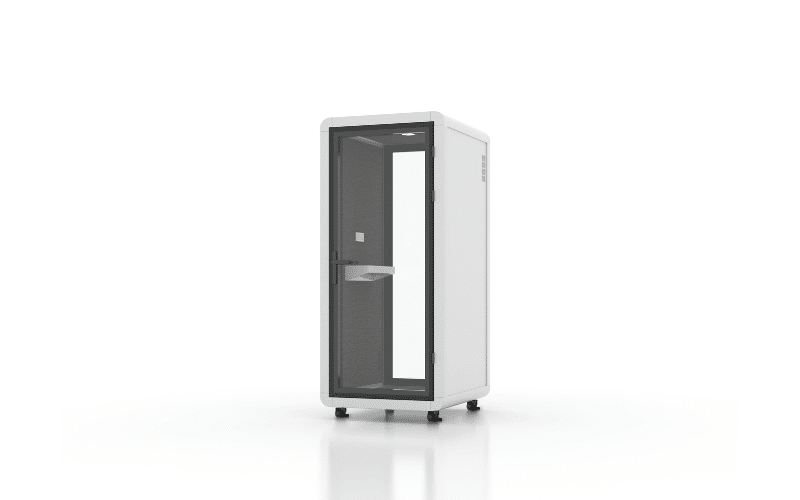
The most widely deployed category. Single-person office phone booths are designed for solo calls, deep-focus sessions, and quick, confidential check-ins. They typically occupy around 1.1–1.2m² of floor space — roughly the footprint of a wardrobe — and can be assembled in a few hours.
Best for: Open-plan teams where employees routinely leave their desks to take calls, hybrid offices where on-site staff need quiet zones during video meetings, and any environment where noise from one person’s call disrupts the surrounding team.
Meeting Pods for 2–4 People
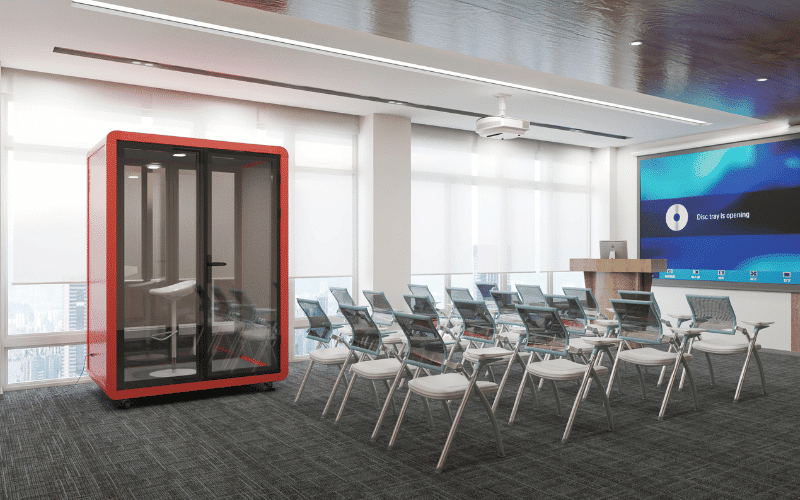
Two- to four-person meeting pods are sized for one-on-ones, performance reviews, small sprint sessions, and client calls. They typically occupy around 2.8m × 2m plus door swing clearance, so floor plan mapping matters before you order.
Best for: Teams whose existing meeting rooms are booked more than 60% of the time during core hours. A 2–4-person acoustic office pod adds meaningful private capacity without requiring a construction project.
Large Conference Pods for 6+ People
Modular conference-scale pods seat six or more people and function as full meeting rooms — complete with integrated AV, acoustic performance, and collaborative seating. These are heavier than smaller units (some models exceed 1,300kg) and require a structural floor loading assessment if installed above ground level.
Best for: Legal practices, financial services firms, and HR departments that regularly conduct sensitive group discussions and need on-demand, compliant acoustic privacy.
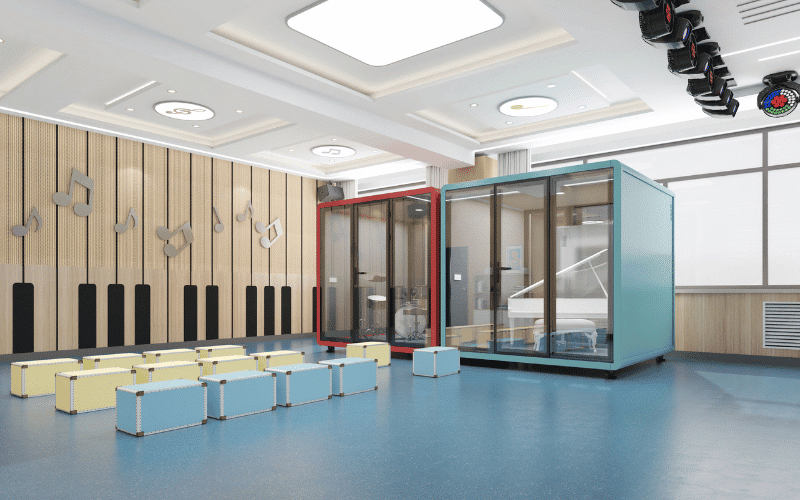
Specialized Pods: ADA-Compliant and Wellness Rooms
ADA-compliant office pods feature wider doorways and accessible interior configurations. Wellness pods are designed as decompression spaces — quieter, softer environments that support mental health breaks and neurodiverse employees who need a sensory refuge from busy open floors. Some configurations also serve as lactation rooms for nursing parents.
Office Pod Comparison Table
|
Pod Type |
Capacity |
Typical Footprint |
Best Use Case |
|---|---|---|---|
|
Single-person phone booth |
1 person |
~1.1–1.2m² |
Solo calls, focused work |
|
Small meeting pod |
2–4 people |
~2.8m × 2m |
One-on-ones, small team meetings |
|
Large conference pod |
6+ people |
Varies by model |
Full team sessions, presentations |
|
ADA-compliant pod |
1–2 people |
Wider than standard |
Accessible private spaces |
|
Wellness/decompression pod |
1 person |
~1.1–1.5m² |
Mental health breaks, quiet recovery |
Key Features to Compare Before You Buy
Acoustic Performance: ISO 23351-1:2020 Explained
The only acoustic standard that matters for office pods is ISO 23351-1:2020. It measures Speech Level Reduction (SLR) — specifically, how intelligible a conversation inside the pod is to someone standing outside. Other standards, such as STC or Rw, were designed for permanent building partitions and don’t translate meaningfully to freestanding furniture enclosures.
Class A (30 dB+ SLR): Conversation inside the pod is not intelligible outside, even in a quiet environment. In a typical busy open-plan office with ambient noise at 60–65 dB, a Class A pod brings internal levels down to around 30–35 dB, below library-level quiet. Required for HR discussions, legal conversations, clinical consultations, and any regulated environment where confidentiality is a legal or ethical obligation.
Class B (28–29 dB SLR): Conversation is largely unintelligible in normal office conditions. An eavesdropper outside can tell a conversation is happening, but cannot follow it. Adequate for regular team meetings, video calls, and focused work.
Three questions to ask any supplier before buying:
- Is this ISO 23351-1:2020 rating from an independent, accredited test laboratory — or an in-house test?
- At what ambient noise level was the test conducted? (A test run at 80 dB ambient will produce a better rating than your quiet office will actually experience.)
- Was the ventilation running during the test? Some manufacturers test with fans off. Real-world performance will be lower if yours are on.
Ventilation
Ventilation is what determines whether people actually want to use a booth — or quietly avoid it.
A poorly ventilated pod becomes stuffy in 10–15 minutes. CO₂ levels rise quickly: at 1,000 parts per million, cognitive performance begins to decline. The accepted minimum for an occupied enclosed space is 20–30 m³/h of fresh air per person.
What to look for:
- Active fan systems rather than passive ventilation — smaller apertures maintain better acoustics while delivering adequate airflow
- Acoustic baffles in the ventilation path so air circulates freely, but sound cannot follow the same route
- Balanced pressure systems that maintain the same air pressure inside and outside the pod — positive pressure differentials can cause discomfort for some users
- An auto-refresh cycle that circulates air even when the pod is unoccupied
Integrated Technology
At a minimum, an office phone booth should include standard AC power outlets, USB-A and USB-C charging ports, and adequate task lighting for video calls. Higher-spec models offer HDMI pass-through, Ethernet ports, and occupancy sensors tied to the ventilation system.
For meeting pods, consider whether the unit supports your existing room-booking or AV integration systems before you order.
Ergonomics
Focused work and video calls can last 60–90 minutes. Interior ergonomics determine whether a booth is actually comfortable for that duration. Check for: adjustable seating, optional sit-stand desk configurations, and lighting quality at eye level. A cramped or poorly lit pod won’t get used — regardless of its acoustic performance.
Benefits of Office Phone Booths
Privacy and Focus
The most direct benefit. Employees have somewhere to take a call without disturbing colleagues and somewhere to do deep work without being disturbed themselves. Both halves of that equation matter. Acoustic office pods address both the noise generation problem (employees making calls at their desks) and the noise reception problem (employees being disrupted by others’ calls) simultaneously.
Reduced Pressure on Meeting Rooms
When meeting rooms double as phone booths, neither function gets served well. Office privacy booths free up formal meeting rooms for collaborative work while giving individuals a designated, appropriate space for solo and small-group calls.
Cost Efficiency Compared to Permanent Construction
Building a new meeting room means permits, contractors, weeks of disruption, and a fixed structure that can’t move. An acoustic office pod is delivered, assembled in hours, and operational the same week. As furniture rather than a fixed asset, pods typically qualify for immediate tax relief under capital allowances — consult your accountant for your specific situation.
Flexibility and Future-Proofing
As your team grows or your floor plan changes, pods move with you. They can be reconfigured, relocated to another area of the office, or moved to a new building entirely. That flexibility has real value for scaling businesses that don’t want to lock capital into permanent structures.
Employee Well-Being and Stress Reduction
Noise is a documented source of workplace stress. Providing dedicated quiet spaces — especially for neurodiverse employees who experience sensory overload — supports a healthier, more inclusive work environment. Office pods that meet WELL v2 acoustic comfort standards contribute directly to workplace wellness programs.
Who Should Buy Office Phone Booths?
Office phone booths deliver the most value in these environments:
- Open-plan offices of 10+ employees where call volume creates ambient noise problems for the wider team
- Hybrid workplaces where employees come in specifically for collaboration but need quiet zones for calls and focus blocks
- Legal, HR, and financial services firms where confidentiality during client conversations is non-negotiable
- Contact centers and customer support teams where high call density means constant ambient noise
- Scale-ups and growing companies that need flexible, expandable privacy infrastructure without committing to permanent construction
- Healthcare and clinical settings where privacy is a regulatory requirement and cleanable interior surfaces matter
Office Phone Booth vs Traditional Meeting Room
|
Factor |
Office Phone Booth |
Traditional Meeting Room |
|---|---|---|
|
Installation timeline |
Hours |
Weeks to months |
|
Planning permission |
Not required (classified as furniture) |
Required in most cases |
|
Cost |
Generally, a lower upfront cost |
Higher due to construction |
|
Relocation |
Yes — movable |
No — permanent fixture |
|
Asset classification |
Office furniture |
Building fixture |
|
Acoustic performance |
ISO-certified (Class A or B) |
Varies widely by build quality |
|
Scalability |
Add units as the team grows |
Requires new construction |
How to Choose the Right Office Phone Booth
Assess Your Floor Space and Layout
Solo pods need approximately 1.1–1.2 m² of floor space, plus a door-swing clearance of around 1.1m in front of the unit. Placement matters as much as quantity — a booth positioned near the entrance of a busy zone gets more use than one in a dead corner. Before finalizing your order, map pod positions against your floor plan and factor in circulation routes.
Verify Ceiling Height
Most pods stand between 2,250mm and 2,326mm tall. Fire safety compliance typically requires 300mm of clear space above the pod for sprinkler access — meaning a minimum room height of approximately 2,400–2,470mm depending on the model. This is the most common oversight in older buildings with suspended ceilings.
Understand Fire Safety Requirements
Fire safety requirements for office pods vary by jurisdiction and building code. All quality office phone booths should be manufactured from fire-retardant materials with certified test results to relevant standards (such as DIN EN 1021 in European markets). However, whether your installation requires integration with the building’s existing fire detection or suppression system — including sprinklers — depends on your local authority and building inspector.
Always clarify this with your building manager or fire safety consultant before installation. A reputable pod supplier will provide full technical documentation to support that process.
Calculate How Many Pods You Need
A widely used starting ratio is one solo pod per 15 employees for general open-plan environments. In call-intensive workplaces — legal practices, financial services, contact centers — that ratio shifts to approximately one per 8–10 people.
For meeting pods, the trigger is meeting room utilization: if your existing rooms are booked more than 60% of the time during core hours, a 2–4 person pod adds meaningful capacity.
Consider Aesthetic Finishes
Acoustic performance is the primary specification. Finishes are a close second for modern offices where design and brand environment matter. Look for a range of exterior colors, interior fabric options, and glass configurations that complement your existing fitout rather than clash with it.
Hardware Durability and Warranty
Doors and seals are the first components to show wear in a high-traffic installation. Ask specifically: How long do door seals last? Are replacement seals available? What does the warranty cover, and for how long? A 5–10 year warranty on structural components is the benchmark for commercial-grade pods.
Office Phone Booth Buying Checklist
Use this before committing to any supplier:
- ISO 23351-1:2020 Class A or B rating with an independent test certificate
- Test conducted with ventilation running (not switched off)
- Independent lab name and test report reference provided on request
- Ventilation airflow rate confirmed (minimum 20–30 m³/h per person)
- Floor space and door-swing clearance mapped against your layout
- Ceiling height verified (minimum ~2,400mm with 300mm sprinkler clearance)
- Floor loading assessed for above-ground installations
- Fire safety requirements confirmed with the building manager
- Power outlet type and capacity verified (most pods are plug-and-play)
- Warranty terms confirmed for panels, door seals, and the ventilation system
- Aesthetic finish options were reviewed against the existing office design
- Quantity ratio calculated against team size and use case
Find the Right Office Phone Booth With OMS Office
At OMS Office, we work with facility managers, HR directors, workplace designers, and founders who need practical acoustic solutions — not a catalogue to wade through alone.
Our team can help you match the right office phone booth or acoustic office pod to your floor plan, team size, and acoustic requirements. Whether you need a single soundproof office booth for a small studio or a multi-unit rollout across a large open-plan floor, we’ll guide you through the specification process from first question to final installation.
[Browse our office phone booth range] or [get in touch with our team] to discuss your specific requirements.
Frequently Asked Questions
Are office phone booths actually soundproof?
No pod is completely soundproof — that term is used loosely in marketing. What a quality acoustic office pod achieves is significant Speech Level Reduction: a Class A pod rated to ISO 23351-1:2020 reduces conversation intelligibility by 30 dB or more, which renders speech unintelligible to someone standing outside, even in a quiet environment. Class B pods (28–29 dB) deliver adequate privacy for most business conversations in normal office ambient conditions.
Does an office phone booth require a building permit?
In most cases, no. Office pods are classified as furniture — not permanent structures — so they fall outside the scope of planning regulations regardless of size. However, integration with a building’s fire detection or sprinkler system may be required, depending on your local building code and inspector. Always confirm this with your building manager before installation.
How many phone booths does an office need per employee?
The widely used benchmark is one solo office phone booth per 15 employees in a general open-plan environment. In call-heavy workplaces — legal, financial services, or contact centers — that shifts to approximately one per 8–10 people. For meeting pods, assess whether your existing meeting rooms are booked more than 60% of core hours; if so, additional capacity is warranted.
Can you move an office phone booth after assembly?
Yes. Most quality office privacy booths are built on leveling feet, with optional hidden casters, and can be repositioned across a floor plan without permits or structural work. This is one of the primary advantages over permanent meeting rooms — the pod is an asset that moves with your business.
How do ventilation systems work in office pods?
Active fan systems draw air in through acoustically baffled ventilation channels, circulate it through the interior, and exhaust it through a separate baffled outlet on the opposite face of the pod. The baffles route sound around corners lined with absorptive material, allowing air to flow freely while blocking the direct acoustic path between interior and exterior. Quality systems include occupancy sensors, auto-refresh cycles, and balanced pressure design for user comfort.
Do office phone booths need to be connected to building power?
Most office phone booths are plug-and-play — they connect to a standard power outlet and require no hard wiring or an electrician for the pod itself. Power consumption is relatively low: a single-person booth typically draws around 40W; larger conference pods draw more, depending on integrated technology. If you’re placing multiple pods in one area, check whether your existing circuits have sufficient capacity.