


Poor work-life balance affects both employees and employers. It can contribute to stress, declining health, lower productivity, strained relationships, and significant financial costs for organizations. Recent research shows that workplace stress remains widespread, while burnout continues to impose a measurable cost on employers.
In practice, work-life balance often erodes gradually. Deadlines extend into evenings, meetings consume productive hours, and the line between work and personal time becomes harder to maintain.
This guide explains the consequences of poor work-life balance, the costs it creates, and the practical steps individuals and organizations can take to improve it.

What Is Poor Work-Life Balance?
Work-life balance refers to the degree to which someone can allocate their time and energy between professional responsibilities and other aspects of life: family, rest, hobbies, health, and social connections. Poor work-life balance occurs when professional demands consistently crowd out personal time, leaving insufficient space to recover and recharge.
This isn’t simply about working long hours. It’s about the ongoing inability to mentally disconnect, set limits, or protect time outside of work. Someone checking emails at 10 PM, skipping meals to meet deadlines, or lying awake running through tomorrow’s to-do list is experiencing poor work-life balance, even if their official hours look reasonable on paper.
What Are the Main Consequences of Poor Work-Life Balance?
Before exploring each area in detail, here is a structured summary of the primary consequences:
- Physical health decline — elevated cardiovascular risk, disrupted sleep, weakened immune response, and musculoskeletal strain from prolonged sedentary work
- Mental health deterioration — burnout, chronic anxiety, depression, and reduced cognitive performance
- Significant employer costs — reduced productivity, absenteeism, and expensive staff turnover
- Damaged personal relationships — reduced presence at home, conflict with family members, and social withdrawal
- Lower job satisfaction and engagement — employees become disengaged, then eventually leave
Each of these is explored in the sections below.
What Are the Health Effects of Poor Work-Life Balance?
Physical health consequences
The physical toll of chronic overwork is well-documented. Sustained stress elevates cortisol levels, which, over time, increases the risk of cardiovascular disease, hypertension, and metabolic disorders. Research consistently links long working hours with higher rates of heart attacks and stroke — outcomes that are difficult to reverse once they take hold.
Sleep is another early casualty. When work bleeds into the hours before bed, or when anxiety about the next day prevents proper rest, sleep quality drops. Poor sleep compounds every other health risk: it impairs immune function, accelerates cognitive decline, and increases the likelihood of developing mood disorders.
For office workers in particular, the physical risks of sedentary work warrant attention. Long hours at a desk — particularly without ergonomic support — contribute to back pain, neck strain, and repetitive stress injuries. These are not dramatic ailments, but they are persistent ones that lower daily quality of life and, over time, require medical attention.
Mental health consequences
Burnout has become the defining occupational health challenge of this decade. According to the 15th annual Aflac WorkForces Report, published in October 2025, burnout among U.S. workers has reached a six-year high. Nearly three in four (72%) U.S. employees face moderate to very high stress at work, with heavy workloads identified as the leading driver of that stress (35%).
Gen Z has overtaken millennials as the most burned-out generation. Aflac’s data shows 74% of Gen Z workers are experiencing at least moderate levels of burnout — a figure that should concern any employer whose workforce skews younger.
Beyond burnout, chronic work-related stress is strongly associated with anxiety and clinical depression. Employees who cannot mentally detach from work show higher rates of both conditions. The Aflac report also found that only 48% of employees feel confident their employers care about their mental health — down from 54% in 2024. That gap between perception and reality has consequences of its own.
What Does Poor Work-Life Balance Cost Employers?
The financial cost of burnout
Burnout is not only a wellbeing issue — it carries a measurable price tag. A 2025 study published in the American Journal of Preventive Medicine, conducted by research teams at CUNY, Johns Hopkins University, Baruch College, and the University of San Diego, used computational modeling to estimate the full financial cost of employee disengagement and burnout to employers.
The results were striking:
- Hourly non-manager employee burnout: $3,999 per employee per year (average)
- Salaried non-manager burnout: $4,257 per employee per year
- Manager burnout: $10,824 per employee per year
- Executive burnout: $20,683 per employee per year
- A 1,000-employee company loses approximately $5.04 million annually from burnout-related costs
These figures account for reduced productivity, absenteeism, and the healthcare consequences of chronic stress. They do not yet include replacement costs when burned-out employees leave entirely.
The cost of turnover
When employees reach the point of resignation, the financial damage escalates further. According to the Society for Human Resource Management (SHRM), replacing a single employee costs between 50% and 200% of that person’s annual salary, depending on seniority and specialization. For a mid-level role paying $70,000, that’s anywhere from $35,000 to $140,000 in recruitment, onboarding, and lost institutional knowledge.
Poor work-life balance is a primary driver of voluntary turnover. Employees who feel consistently overwhelmed and unsupported don’t simply underperform — they leave. And the talent they take with them is rarely easy or cheap to replace.
How Does Poor Work-Life Balance Affect Families and Relationships?
The effects of an imbalanced work life rarely stay contained to work. Stress and exhaustion travel home with employees, and the people closest to them absorb the fallout.
Parents who are chronically overworked have less mental and emotional bandwidth for their children. Partnerships suffer when one or both individuals are consistently depleted. Social relationships — friendships, extended family connections — tend to be deprioritized first because they feel like the most flexible part of the schedule. Over time, that isolation reinforces stress rather than relieving it.
The Aflac WorkForces Report identifies a meaningful counterpoint: employees who feel a genuine sense of belonging and support in their workplace report significantly lower stress levels (30%) than those who don’t (56%). The data suggests that connection itself — whether at home or at work — functions as a protective buffer against burnout. Erode both, and the consequences compound.
What Causes Poor Work-Life Balance in the Workplace?
Poor work-life balance rarely has a single cause. More often, it emerges from several overlapping pressures:
- Excessive workloads — Aflac’s 2025 data identifies this as the single most common driver of stress, cited by 35% of employees
- Always-on expectations — the normalization of after-hours emails, Slack messages, and “quick” weekend check-ins
- Unclear role boundaries — when responsibilities are poorly defined, scope tends to expand to fill available time
- Inadequate staffing — teams that are chronically understaffed push remaining employees into unsustainable patterns
- Poor management — managers who don’t model healthy limits, or who reward presenteeism over output, set a dysfunctional tone
- Physical work environment — open-plan offices, noisy common areas, and the absence of spaces for focused work create constant interruption cycles that push actual work into overtime hours
That last point is underappreciated. When employees cannot focus during core hours because of noise, interruptions, or a lack of private space, tasks that should take two hours routinely take four. The deficit gets recovered through longer days — not because the workload increased, but because the environment failed to support effective working.
How Can You Improve Work-Life Balance? Practical Habits and Strategies
For individuals and organizations alike, work-life balance is not a passive state — it requires deliberate maintenance.
For employees
- Set clear finish times and protect them. Decide when your working day ends and treat that boundary as a commitment. Inform your team. Disable after-hours email notifications where possible.
- Protect your recovery time. Sleep, exercise, and genuine leisure are not luxuries — they are inputs to sustained performance. Treat them as non-negotiable.
- Communicate proactively about workload. When expectations consistently exceed available time, that needs to be surfaced. Keeping quiet protects no one.
- Create transition rituals. A short walk, a change of environment, or a brief journaling habit can help signal to the brain that the working day is over. Psychological detachment is a skill that improves with practice.
For employers and managers
- Audit workloads regularly. Chronic overtime is a data point, not just a personal complaint. If teams are consistently working beyond their contracted hours, the work itself needs to be reassessed.
- Model the behavior you want to see. Managers who send emails at midnight and return from holidays with a thousand unread messages signal — whatever they say explicitly — that overworking is valued.
- Build belonging into your culture. The Aflac data shows that employees who feel they belong experience substantially lower stress. Fostering connection, recognition, and psychological safety is not soft work — it is a business intervention with measurable returns.
- Provide access to mental health resources. Employee Assistance Programs, access to counseling, and regular wellbeing check-ins cost a fraction of what burnout-related turnover and lost productivity cost.
How Can Workplace Design Help Improve Work-Life Balance?
The physical environment shapes behavior in ways that are easy to overlook. An office that fails to provide conditions for focused work doesn’t just create frustration in the moment — it drives unintentional overtime as employees compensate for lost productive hours.
Acoustic privacy and focused work
Open-plan layouts generate constant ambient noise that makes deep, concentrated work harder. Research published in the journal Building and Environment found that moving from an active open-plan zone to a dedicated quiet zone increased cognitive performance by 16.9%. That is a substantial productivity gain from a change in environment rather than a change in effort.
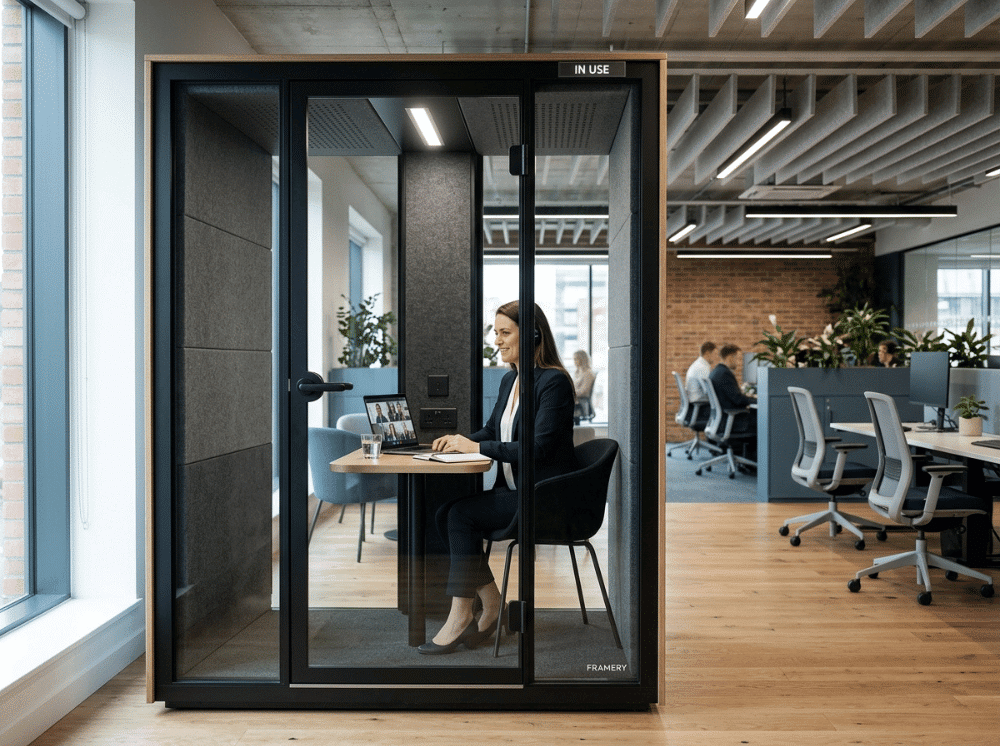
Office phone booths — small, acoustically isolated pods designed for calls, focused work, and private conversations — address this directly. When employees have access to a quiet, enclosed space, they can complete cognitively demanding tasks without the friction of constant interruption. The result is often a more complete working day within contracted hours, which reduces the implicit pressure to extend that day into evenings.
At Omsoffice, our office phone booths are engineered for acoustic performance and modular flexibility, making them a practical addition to modern commercial office layouts of any size.
Ergonomic workstations
Poor posture and physical discomfort are slow-acting stressors. Height-adjustable tables allow employees to alternate between seated and standing positions throughout the day, reducing the musculoskeletal strain associated with prolonged desk work. This isn’t a wellness gesture — it’s a practical investment in the physical sustainability of the workday.
Adaptable space planning
Demountable wall systems allow organizations to reconfigure office space as team structures and working styles evolve. Dedicated focus areas, collaborative zones, and private meeting spaces can coexist within a single floor plan — giving employees appropriate spaces for different kinds of work, rather than forcing every task into one undifferentiated environment.
Start Addressing the Consequences of Poor Work-Life Balance
The consequences of poor work-life balance are serious, measurable, and not inevitable. Burnout at a six-year high, employer costs approaching $21,000 per executive per year, and strained relationships at home — these are not background conditions that employees simply have to endure. They are outcomes that respond to deliberate intervention.
For organizations ready to act, the starting point is usually an honest assessment: What is actually driving extended hours? What signals is the work environment sending? What support structures exist — and are employees actually using them?
Workplace design is one operational lever among many. Acoustic privacy, ergonomic support, and thoughtful space planning don’t resolve systemic workload problems on their own. But they remove unnecessary friction, reduce the environmental drivers of unintentional overtime, and signal that focused, sustainable work is valued.
If you’re reviewing your workspace with these priorities in mind, explore Omsoffice’s range of office solutions — from soundproof phone booths to height-adjustable tables — designed to support a healthier, more productive working environment.
Frequently Asked Questions About Poor Work-Life Balance
What are the most common signs of poor work-life balance?
The most common signs include consistently working beyond contracted hours, difficulty mentally switching off from work, chronic fatigue, irritability at home, declining interest in personal activities, and frequent feelings of overwhelm. Physical symptoms such as disrupted sleep, headaches, and back pain often appear alongside emotional indicators.
How much does poor work-life balance cost employers?
According to a 2025 study published in the American Journal of Preventive Medicine, burnout costs employers between $3,999 and $20,683 per employee per year, depending on the employee’s role. A 1,000-employee company loses approximately $5.04 million annually from disengagement and burnout. Turnover costs add an additional 50%–200% of the annual salary per employee replaced, according to SHRM.
What is the difference between work-life balance and burnout?
Work-life balance describes the ongoing distribution of time and energy between professional and personal domains. Burnout is a clinical outcome of prolonged work-related stress, characterized by emotional exhaustion, depersonalization, and a reduced sense of personal accomplishment. Poor work-life balance is one of the primary pathways to burnout, but burnout is a more severe and distinct condition requiring its own intervention.
Which industries or demographics are most affected by poor work-life balance?
According to the 2025 Aflac WorkForces Report, Gen Z workers are the most burned-out demographic, with 74% experiencing at least moderate burnout. African Americans and U.S. Hispanics are also disproportionately affected by workplace stress. Across industries, sectors with high workloads, irregular hours, and limited autonomy — including healthcare, technology, and financial services — tend to report the highest rates of imbalance.
How long does it take to recover from burnout caused by poor work-life balance?
Recovery timelines vary significantly depending on the severity of burnout, access to support, and changes in underlying conditions. Mild burnout may resolve within weeks with adequate rest and boundary-setting. Severe burnout — involving clinical anxiety or depression — may require months of structured recovery, including professional support. The most important factor is removing or significantly reducing the stressors that caused burnout in the first place.
Can office design really make a difference to work-life balance?
Workplace design doesn’t resolve systemic workload problems, but it addresses environmental factors that contribute to overwork. When employees lack acoustic privacy or a dedicated space for focused work, tasks take longer than they should — pushing work into overtime hours. Research shows that access to quiet, separated workspaces can increase cognitive performance by up to 16.9%. Solutions such as office phone booths, ergonomic workstations, and adaptable space layouts reduce friction and support more efficient working within normal hours.