

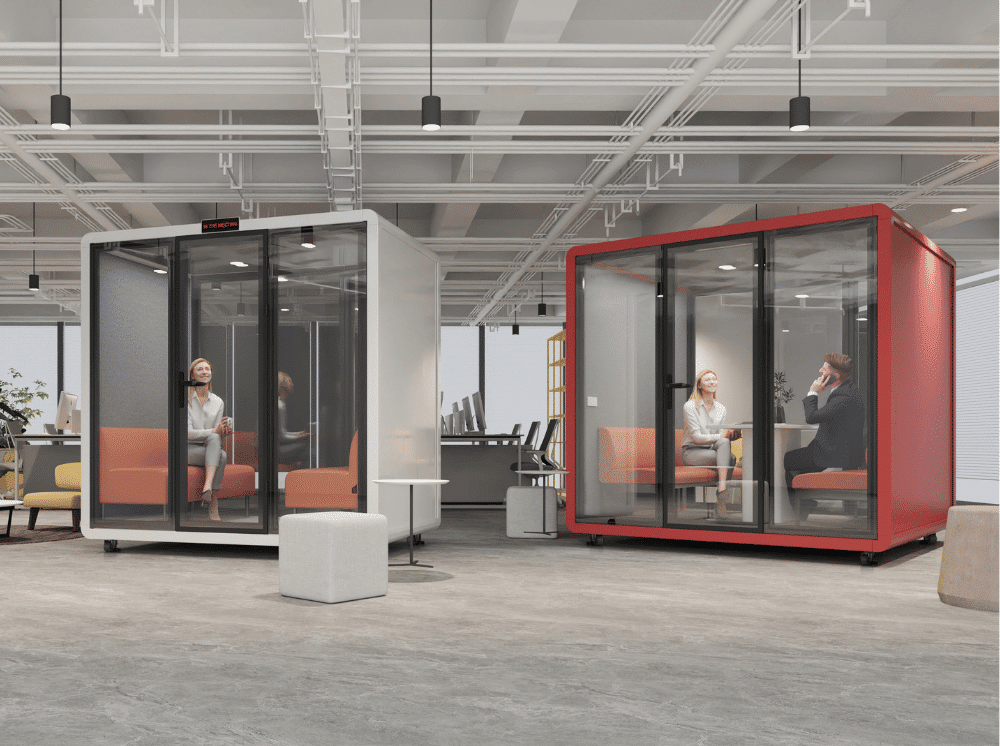
Office phone booths range from roughly $4,000 for a compact solo unit to $25,000+ for a custom, bespoke enclosure, with multi-person pods and large conference enclosures in between. But the sticker price is only part of the story. Freight, installation, electrical work, fire code compliance, and furniture add-ons can push your actual spend 20–40% above the base quote. This guide breaks down 2026 US market pricing by booth size, unpacks every hidden cost worth tracking, compares pods to drywall construction, and walks through what “total cost of ownership” actually looks like — so you can build an accurate budget before you request a single quote.
Key Takeaways
- Solo phone booths typically cost $4,500–$11,500 in 2026, depending on materials, acoustic performance, and brand.
- Multi-person pods run $8,000–$42,500+, with pricing that scales with capacity, acoustic engineering, and integrated technology.
- Hidden costs — freight, installation, permitting, and furniture — routinely add 15–30% to the base price.
- Drywall construction for a comparable private office costs $20,000–$58,000+, making pods significantly more cost-effective in most scenarios.
- Used booths can reduce upfront costs by 20–40%, but acoustic degradation, missing warranties, and unknown maintenance histories pose real risks.
- Section 179 depreciation may apply to phone booths classified as movable furniture — consult a qualified tax professional to confirm eligibility for your situation.
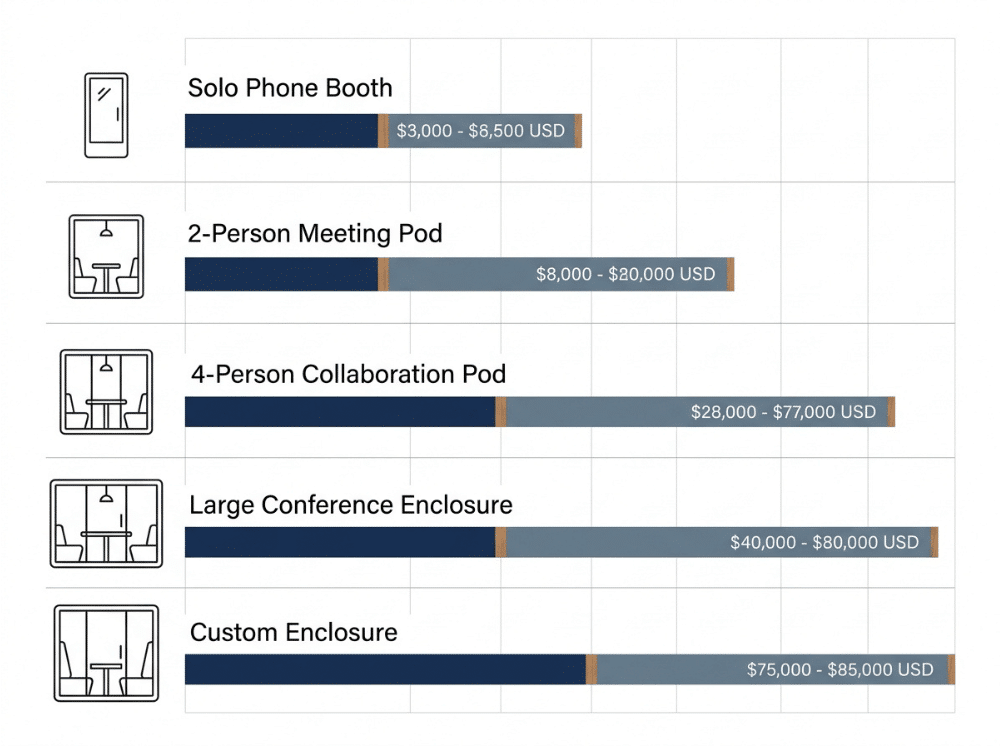
Office Phone Booth Cost at a Glance (2026)
|
Booth Type |
Capacity |
2026 Price Range (USD) |
Typical Use Case |
|---|---|---|---|
|
Solo Phone Booth |
1 person |
$4,500 – $11,500 |
Private calls, focused work |
|
2-Person Meeting Pod |
2 people |
$8,000 – $17,750 |
1:1s, interviews, small meetings |
|
4-Person Collaboration Pod |
3–4 people |
$12,000 – $19,500 |
Team huddles, video calls |
|
Large Conference Enclosure |
5–8+ people |
$18,750 – $42,500+ |
All-hands calls, confidential meetings |
|
Custom / Bespoke Enclosure |
1–8+ people |
$15,000 – $25,000+ |
Branded builds, bespoke configurations |
Prices reflect current US market ranges and vary based on brand, materials, acoustic rating, and configuration. Always request a fully delivered quote.
Office Phone Booth Pricing by Size
Solo Phone Booths (1 Person)
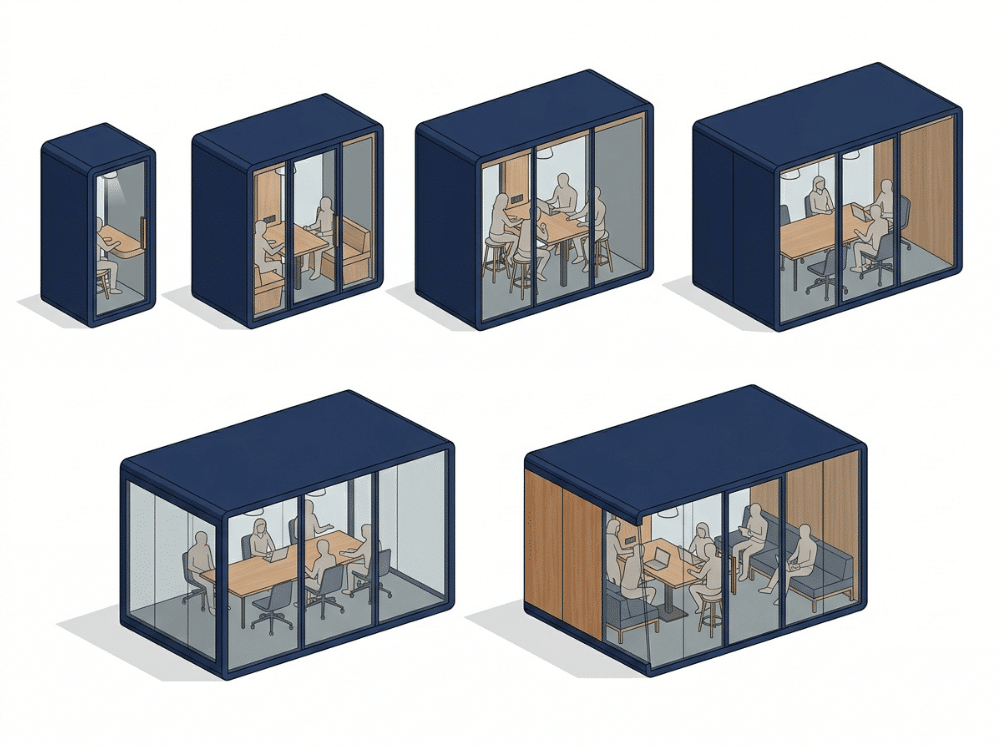
Single-occupancy booths represent the most common entry point for open-plan offices. Current US market pricing generally falls between $4,500 and $11,500, with the bulk of mid-market options sitting in the $6,000–$8,500 range when fully equipped and delivered.
Budget-tier units at the lower end of the range tend to use aluminum frames, standard acoustic panels, and basic ventilation. Premium single-person booths — those targeting Class A acoustic performance under ISO 23351-1 — tend to be on the higher end, incorporating laminated acoustic glass, stainless steel frames, and integrated smart sensors for occupancy and air-quality monitoring.
For most procurement decisions, a single-person booth in the $6,000–$8,000 range delivers a strong balance of acoustic performance (typically 28–35 dB noise reduction), durability, and feature completeness.
2-Person Meeting Pods
Two-person pods serve a different function than solo booths — they’re built for structured conversations: 1:1 check-ins, candidate interviews, and HR discussions that can’t happen in the open office. Current market pricing ranges from approximately $8,000 to $17,750, with the wide spread driven largely by seating configuration, acoustic paneling density, and the quality of the structural frame.
At the higher end, two-person pods include upholstered bench seating, adjustable desk surfaces, integrated power modules, and acoustic-sealed door frames that deliver genuine speech privacy. At the lower end, expect basic seating, standard panel systems, and acoustic ratings that may underperform in noisier environments.
4-Person Collaboration Pods
Four-person pods represent a meaningful jump in both size and cost. These units typically run $12,000–$19,500 and are engineered to serve as on-demand meeting rooms — practical alternatives to booking a conference room for a quick team sync.
The cost increase relative to solo booths is driven by proportionally more acoustic paneling, a larger ventilation system, a heavier structural frame, and integrated meeting-room features (monitor mounts, cable management, central-table configurations). Units toward the upper end often include modular expansion options — the ability to add or remove panels as your team’s needs evolve.
Large Conference Enclosures (6+ Persons)
Conference-scale enclosures designed for six to eight or more occupants occupy a distinct pricing tier: $18,750–$42,500+ for standard configurations. Modular “room-within-a-room” systems designed to replace a full, permanent conference room can reach $59,999 or more for large footprints.
At this size, the value proposition shifts meaningfully. A large acoustic enclosure is beginning to directly compete with drywall construction — and, in most cases, still wins on flexibility, lead time, and total cost. These units typically include optional conference tables, multi-zone lighting, and dedicated HVAC provisions.
Custom and Bespoke Enclosures
Custom booths — those incorporating branded finishes, non-standard dimensions, integrated AV systems, or proprietary materials — generally start at $15,000 and can exceed $25,000 per unit. Lead times for bespoke builds run longer than standard configurations, typically 8–14 weeks. Factor this into project timelines if your office fit-out has a hard deadline.
What Affects Office Phone Booth Pricing?
Understanding the cost drivers lets you make sharper trade-offs when comparing quotes.
Frame and Glazing Materials
Aluminum frames are lighter and less expensive to ship, but they soften and warp over the years of daily use. Stainless steel frames hold their shape and maintain acoustic performance longer — which is why steel-framed units typically carry longer warranties (3–5 years versus 1–2 years for aluminum). Glazing quality matters too: laminated acoustic glass performs significantly better than standard tempered glass in isolating speech.
Acoustic Performance (STC Rating)
Acoustic performance is the specification that most directly justifies the purchase. Budget units typically achieve 25–28 dB of noise reduction. Mid-range and premium units push to 30–40 dB, with the best performers achieving an ISO 23351-1 Class A rating. Each step up in acoustic performance requires denser panels, better door seals, acoustic gaskets, and more refined manufacturing — all of which add cost.
The practical implication is that in a moderately noisy open office, a 28 dB booth usually suffices for calls. In a high-density floor with open sales teams or call centers nearby, Class A performance (30+ dB) becomes the relevant baseline.
Ventilation System Quality
Effective ventilation is non-negotiable. Enclosed booths without adequate airflow become uncomfortable within minutes, reducing actual usage and eroding your return on investment. Quality ventilation systems that maintain continuous fresh air exchange cost more than basic single-fan setups but are essential for booths that will see sustained daily use.
Integrated Technology
Standard booths include power outlets and USB ports. Premium configurations add occupancy sensors, air quality monitoring, smart lighting with motion detection, monitor mounts, and software integrations with room booking platforms. Each technology layer adds $500–$2,000 or more to the base price.
Finishes and Customization
Standard colorway options rarely add cost. Custom brand colors, specialty fabric upholstery, frosted glass configurations, and exterior branding typically add 10–20% to the base price. Budget for this separately if brand consistency in your fit-out is a priority.
Mobility Features
Booths with lockable casters that allow relocation with a push command are a slight premium over static-frame designs. For growing companies that expect floor plan changes, mobility features are worth the incremental cost — they protect the asset’s long-term value.
Hidden Costs of an Office Phone Booth
The advertised price is almost never the full delivered cost. Here’s where procurement teams are frequently caught off guard.
Freight and White-Glove Delivery
Freight charges for heavy acoustic panels and structural components can range from $300 to $2,000+, depending on delivery distance, building access, and whether white-glove inside delivery is required. Some vendors include freight in the sticker price; others do not. Always confirm before comparing quotes side by side.
Installation and Assembly
Self-install pods that ship flat-pack and assemble in 1–2 hours save you a professional installation fee entirely. Complex multi-panel configurations often need a two-person crew and can take 4–8 hours. If the vendor doesn’t include installation in the quote, add $500–$1,500 for a professional assembly team, depending on unit size and local labor rates.
Building Access Challenges
High-rise buildings, older properties with narrow elevator shafts or low-clearance freight entrances, and multi-tenant buildings with restricted delivery windows can add unforeseen logistics costs. Walk your freight path before finalizing a booth order — a unit that doesn’t fit in the service elevator requires costly partial assembly in the loading dock.
Electrical Permits and Hardwiring
Most indoor phone booths operate on standard 120V outlets and require no electrical permit. Larger conference enclosures may need dedicated circuits, which can add $800–$2,500 in electrical contractor costs depending on your building’s existing panel capacity. Confirm this with your facilities team before purchase.
Note: Permit requirements vary by jurisdiction. Consult a licensed electrician and your building management to confirm local requirements.
Fire Code and Sprinkler Compliance
In some jurisdictions and building types, adding a fully enclosed structure — even a non-permanent one — triggers fire code review and may require integrated sprinkler provisions. This isn’t universal, but it’s a risk worth surfacing early. Facilities managers in older or Class B office buildings should verify compliance requirements with their landlord and a qualified fire safety professional before installation.
Seismic anchoring requirements may also apply in high-seismic zones. Consult a structural engineer or your local building authority if you’re in a relevant zone.
Furniture Add-Ons
Desks, ergonomic chairs, stools, and sofa benches are sometimes bundled into the booth price and sometimes sold separately. Furniture add-ons can range from $100 to $900+ per piece, depending on specifications. Clarify what’s included in the base quote before assuming the booth arrives move-in ready.
Ongoing Maintenance
Phone booths are lower-maintenance than most office equipment, but they’re not maintenance-free. Budget for periodic ventilation filter cleaning, door seal inspections, and acoustic gasket replacement over the unit’s lifespan. Premium vendors include maintenance guidance in their warranty documentation; budget units often do not.
The 15% Contingency Rule
As a general procurement rule, add 15% to your base quote before presenting a phone booth budget internally. In practice, freight, installation, minor electrical work, and at least one furniture add-on reliably consume that buffer. Building it in from the start prevents budget revision conversations after the order is placed.
Office Phone Booth Total Cost of Ownership (TCO Checklist)
Use this checklist to build a complete TCO calculation before finalizing any purchase decision.
One-Time Costs
- Base unit price (per booth, per quantity)
- Freight and delivery charges
- White-glove or inside delivery premium (if applicable)
- Installation and assembly labor
- Building access logistics (elevator booking, freight dock fees)
- Electrical permit and contractor work (if required)
- Fire code compliance review (if applicable)
- Furniture add-ons (chairs, desks, stools)
- Optional technology integrations (sensors, booking hardware)
Ongoing Annual Costs
- Ventilation filter replacement and maintenance
- Door seal and acoustic gasket inspections
- Cleaning supplies suitable for acoustic panels
- Booking platform or software subscription (if using smart booth management)
- Extended warranty or service plan premium (if elected)
Offset Considerations
- Section 179 depreciation value (consult your tax advisor)
- Reduction in real estate square footage needed for permanent rooms
- Recovered employee productivity value (estimated)
- Avoided future relocation costs (if unit is mobile)
Example Budget Scenarios
Scenario 1: Single Solo Booth for a Small Office (15–30 employees)
|
Line Item |
Estimated Cost |
|---|---|
|
Solo phone booth (mid-market) |
$7,000 |
|
Freight and delivery |
$600 |
|
Self-installation |
$0 |
|
Desk and stool add-on |
$400 |
|
Electrical (standard outlet, no permit needed) |
$0 |
|
15% contingency buffer |
$1,200 |
|
Estimated Total |
~$9,200 |
Scenario 2: Multi-Pod Deployment for a Hybrid Team (50–100 employees)
|
Line Item |
Estimated Cost |
|---|---|
|
3x solo phone booths (mid-market, $7,000 each) |
$21,000 |
|
2x 4-person collaboration pods ($15,000 each) |
$30,000 |
|
Freight and delivery (all units) |
$2,500 |
|
Professional installation (2 days, 2-person crew) |
$2,000 |
|
Electrical (1 dedicated circuit for large pod) |
$1,200 |
|
Furniture add-ons across all units |
$2,500 |
|
15% contingency buffer |
$8,730 |
|
Estimated Total |
~$67,930 |
These figures represent illustrative estimates based on current 2026 market benchmarks. Actual costs will vary based on vendor, location, and building conditions. Request fully delivered, itemized quotes before finalizing your budget.
Office Phone Booth vs. Drywall Room Cost
The comparison that most procurement teams need to make explicit — pods versus permanent construction.
|
Cost Factor |
Office Phone Booth |
Drywall Construction |
|---|---|---|
|
Unit cost (1-person) |
$4,500 – $11,500 |
$20,000 – $30,000+ |
|
Permits required |
Rarely |
Almost always |
|
Construction time |
Hours |
Weeks to months |
|
Operational disruption |
Minimal |
Significant |
|
Portability |
Yes (most models) |
None |
|
Fits in lease renewal |
Yes — moves with you |
No — stays with the building |
|
Fit-out cost per sq ft (2026 avg) |
N/A — self-contained |
~$149/sq ft (Cushman & Wakefield, 2026) |
|
ROI breakeven |
~6–7 months |
3–5+ years |
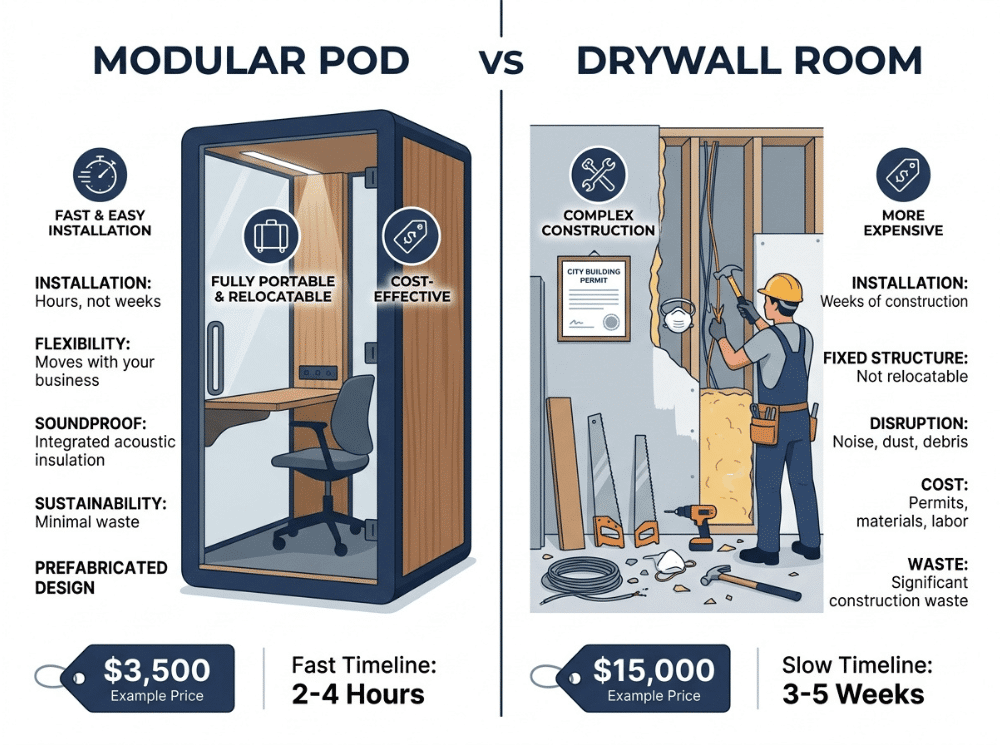
The math consistently favors pods. A 64 sq ft private office built via traditional construction — framing, drywall, electrical, HVAC, flooring, interior fit-out, and permitting — carries a realistic cost range of $17,800 to $58,500 or more, depending on specification. That same investment in quality acoustic booths gives you multiple units, broader coverage across a floor plan, and assets that move with your business when your lease ends.
According to Cushman & Wakefield’s Office Fit Out Cost Guide Americas 2026, average commercial office fit-out costs reached $149 per square foot in early 2026 — a 5.5% increase from 2025. At that rate, a 150 sq ft traditional meeting room carries a fit-out cost of roughly $22,350 before any furniture. A quality 4-person collaboration pod achieves functionally the same outcome for $12,000–$19,500, installs in hours, and can be relocated when you don’t renew that lease.
New vs. Used Office Phone Booths
When Used Makes Sense
A secondary market for office acoustic pods does exist, primarily through commercial furniture dealers and office liquidation channels. Used units can reduce upfront cost by 20–40% — a meaningful discount on a high-price-point purchase. For cost-conscious buyers with flexible acoustic requirements and shorter expected deployment periods, a used booth can be a rational decision.
Risks to Weigh
The risks are real and worth quantifying before purchasing used:
- Acoustic degradation. Door seals, acoustic gaskets, and panel adhesives all degrade with use. A used booth that originally achieved 32 dB noise reduction may perform at 24 dB today — below the threshold where it meaningfully improves privacy.
- No warranty. Most used transactions carry no manufacturer warranty. If a component fails, replacement parts may be difficult to source.
- Unknown maintenance history. Ventilation systems in booths that aren’t regularly serviced can accumulate particulate matter. Request documentation of maintenance history if buying used.
- Obsolete technology. Older booths may lack USB-C power, smart-sensor compatibility, or the electrical specifications required for current AV equipment.
- Hidden freight and reconditioning costs. Used booths often require professional cleaning, gasket replacement, and panel reconditioning before deployment — costs that erode the initial price advantage.
The general guidance is: if acoustic performance is the primary reason you’re buying the booth, purchase a new one with a verifiable warranty. If budget constraints are significant and use cases are light (occasional private calls in a moderately quiet environment), a well-sourced used unit from a reputable commercial furniture dealer may be appropriate.
How to Choose the Right Office Phone Booth for Your Budget
Match Booth Type to Actual Use
Before pricing anything, audit how your team actually uses space. If 80% of the need is solo video calls, a fleet of solo booths serves you better than two large pods that sit at 30% utilization. Industry benchmarks suggest a starting ratio of 1 booth per 6–12 employees, adjusted based on your office’s noise profile and hybrid attendance patterns.
Calculate Cost Per Square Foot
A solo phone booth occupies 12–16 sq ft and delivers complete acoustic privacy in that footprint. A traditional private office occupies 64–100 sq ft and costs dramatically more to build. Framing cost-per-square-foot comparisons helps stakeholders understand the value proposition quickly and builds a stronger internal business case.
Request Fully Delivered Quotes
Never compare base prices side by side. Always request an all-in quote that includes freight, standard installation, and any required accessories. Hidden delivery fees are the most common source of budget overruns in phone booth procurement.
Explore Volume and Timing Discounts
Vendors commonly offer tiered pricing for orders of three or more units, end-of-quarter timing incentives, or freight discounts for multi-unit shipments to a single location. If your deployment plan includes five or more booths, negotiate volume pricing before finalizing.
Get Three Quotes
At minimum. The acoustic pod market has expanded significantly, and price variation between comparable specifications can be substantial. Three competing quotes also give you leverage in final negotiations and surface differences in warranty terms, lead times, and included services.
Consider Financing
Office phone booths qualify as depreciable business assets in most accounting frameworks. Financing options — whether through the vendor, a commercial lender, or a leasing arrangement — can convert a large capital expense into manageable monthly payments while preserving cash for other operational priorities. Consult your financial advisor to determine the most tax-efficient approach for your organization, including whether Section 179 expensing applies to your specific situation.
Make Smarter Procurement Decisions with OMS Office
Choosing the right acoustic booth isn’t just a product decision — it’s a workplace strategy decision with real financial implications. Getting the specification wrong means overpaying for performance you don’t need, or underspending on a unit that frustrates your team from day one.
OMS Office works with facilities managers, operations leads, and procurement teams to assess their actual acoustic needs, identify the right configuration for their floor plan, and source solutions that fit the full-delivered budget — not just the sticker price. If you’re building a business case for a booth deployment or comparing multiple options, we’re ready to help you structure that evaluation.
[Request a consultation or quote from the OMS Office today.]
Frequently Asked Questions
How much does an office phone booth cost in 2026?
Single-person office phone booths currently range from approximately $4,500 to $11,500 in the US market, depending on materials, acoustic rating, and brand. Mid-market units fully equipped and delivered typically land between $6,000 and $8,500. Multi-person pods and conference enclosures range from $8,000 to $42,500+. Always request a fully delivered quote that includes freight, installation, and any furniture add-ons.
Do office phone booths require a building permit in 2026?
Most phone booths do not require a permit because they’re classified as modular, non-permanent furniture rather than permanent construction. They don’t require HVAC modification or structural changes in standard deployments. However, requirements vary by jurisdiction and building type. Always confirm with your building management and local authority before installation, particularly in older buildings or those with strict fire code interpretations. This does not constitute legal or regulatory advice — consult qualified professionals for your specific situation.
How does an office phone booth compare in cost to a drywall office?
A drywall private office (approximately 64 sq ft) costs $17,800–$58,500 or more to construct once you account for framing, electrical, HVAC, flooring, interior fit-out, and permits. A comparable solo acoustic booth costs $4,500–$11,500, installs in hours, requires no contractors or permits in most cases, and can be relocated when your lease ends. Most organizations see ROI breakeven on booth investment within 6–7 months through recovered productivity.
What are the hidden costs of office phone booths?
The most common hidden costs include freight and delivery ($300–$2,000+), professional installation labor ($500–$1,500 for complex units), electrical work for larger enclosures ($800–$2,500), furniture add-ons ($100–$900+ per piece), and fire code compliance review in certain buildings. Budget a 15% contingency above your base quote to account for these variables.
Can office phone booths qualify for the Section 179 tax deduction?
Phone booths classified as movable furniture — rather than permanent building improvements — may qualify for Section 179 depreciation in the year of purchase, potentially allowing you to expense the full cost rather than depreciate it over multiple years. Tax treatment varies by situation. Consult a qualified tax professional to confirm eligibility and the most advantageous depreciation approach for your organization.
Is it worth buying a used office phone booth?
Used booths can reduce upfront cost by 20–40%, but they introduce meaningful risks: acoustic seal degradation, no warranty coverage, unknown maintenance history, and potentially obsolete electrical specifications. If acoustic performance is the core reason for your purchase, new units with manufacturer warranties are the safer investment. Used units may be appropriate for light-use scenarios where budget constraints are significant and acoustic requirements are moderate.
How many office phone booths does a typical office need in 2026?
Industry guidance suggests a starting ratio of 1 single-person booth per 6–12 employees, adjusted based on your office’s noise profile, the proportion of hybrid workers on peak attendance days, and the availability of other quiet spaces. Track utilization data for the first 60–90 days after deployment and redistribute or add units based on actual demand rather than assumptions.
How long does it take to install an office phone booth?
Self-install booths designed for flat-pack delivery typically take 1–2 hours for a single unit with two people. More complex multi-panel configurations or large conference enclosures can take 4–8 hours and may benefit from professional installation crews. Modular acoustic booths require no structural modifications to the building, which is why they can be deployed in a fraction of the time it takes to build drywall.