
Most offices want daylight and an open feel. But people still need places where nobody watches them work, meet, or take a hard call. Clear glass leaves them on display. Solid walls turn rooms into boxes.
I have helped many offices find a middle path with frosted glass office partitions. They let light flow and block the sightlines that matter. The key is knowing what to hide, from whom, and at what height. This guide shows you how to pick the right privacy level and finish for each room, so you spend money only where it counts.
Why Offices Use Frosted Glass Partitions
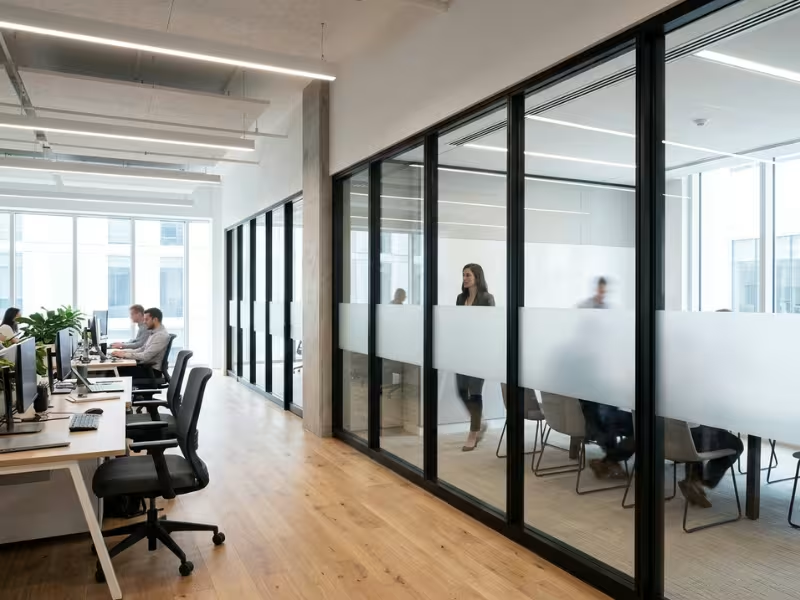
When clients ask me about frosted glass, they rarely start with the glass itself. They describe a room that feels wrong. Maybe a manager feels watched, or a meeting room leaves everyone on show. Frosted glass fixes these problems in five ways.
Light keeps moving. Frosted glass softens daylight instead of stopping it. Interior rooms stay bright, and the desks behind them don’t fall into shadow.
Distractions drop. Constant foot traffic past a clear wall pulls eyes away from screens. A frosted band hides that movement, so the people inside can focus.
Privacy doesn’t mean a box. You get a screened room without the closed-in feel of drywall. People inside can still sense activity on the other side.
Rooms look finished. A well-placed frost line makes a meeting room or office look calm and intentional, not like a fishbowl.
Updates stay simple. If your team or branding changes, an installer can swap frosted film in an afternoon. Changing a solid wall means demolition and fresh paint. In offices that expect regular layout changes, demountable wall systems make those updates even easier, because whole glass modules can move along with the film.
Keep one limit in mind. Frosted glass controls what people see, not what they hear. A frosted pane leaks speech just as easily as a clear one. If a room needs speech privacy, the glass build, seals, and door have to handle that job.
Privacy Levels: What Frosted Glass Really Hides
Before I suggest a frost style, I ask one question: who are you hiding from, and are they sitting or standing? Each privacy level blocks a different set of sightlines. Pick the wrong one, and you either leave people exposed or close them in for no reason.
Start with this quick comparison. The notes below show how each level behaves in a real room.
|
Frost style |
What it hides |
Best room types |
Main trade-off |
|---|---|---|---|
|
Full frost |
Faces, screens, and body language from almost every angle |
HR offices, medical rooms, interview and counseling rooms |
Rooms can feel closed, and nobody can tell if the room is in use |
|
Mid-band / partial frost |
Seated people, desks, and laptop screens |
Meeting rooms, private offices, focus rooms |
Standing people stay visible, and band height must suit the furniture |
|
Gradient / patterned frost |
Blurs detail and softens views without fully blocking them |
Reception areas, collaboration rooms, executive suites |
Shapes and movement still show through the clear gaps |
Full Frost: Maximum Cover, Less Connection
Full frost covers the panel from floor to ceiling, or close to it. People outside see blurred shapes and light, nothing more. Screens, faces, and paperwork stay out of view.
I specify it for rooms where being seen is a problem in itself. HR meetings, medical consultations, and tough performance reviews all fit here. In these rooms, nobody should have to wonder who is walking past.
The trade-off is connection. A fully frosted room can feel like a box, and colleagues can’t tell whether it’s free. I often leave a clear strip of about 100 to 150 mm at the top. More light gets in, and the room feels less sealed off.
Mid-Band Frost: Private When Seated, Visible When Standing
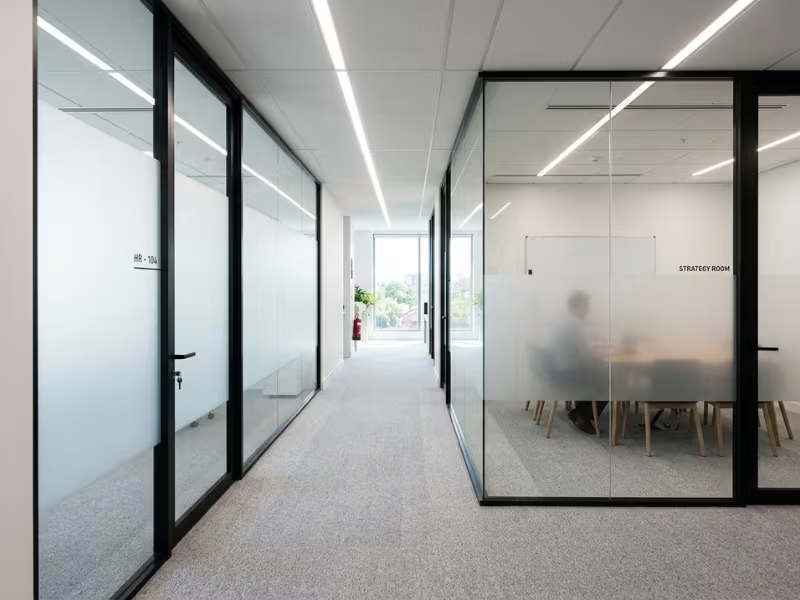
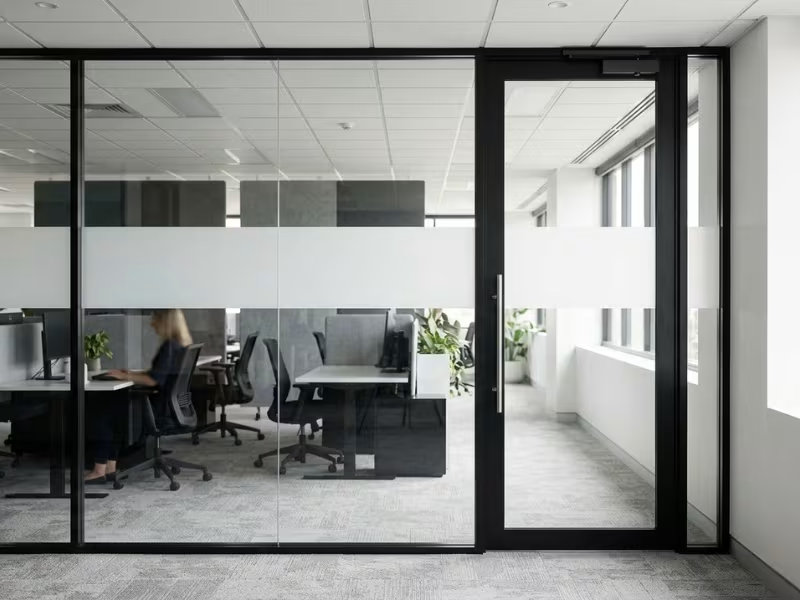
This option strikes the right balance for most meeting rooms. A frosted band runs across the glass, usually from about 900 mm to 1,500 mm above the floor. That range covers the eye level of seated people and the tops of laptop screens.
Anyone sitting inside gets privacy. Anyone standing, such as a presenter or someone checking whether the room is free, stays visible. The clear glass above keeps daylight moving across the floor.
Check your furniture before you lock in the band. High tables and stools can lift eye level by 200 mm or more. A band set for standard chairs may miss them completely.
Gradient and Patterned Frost: Soft Screens, Not Solid Blocks
Gradients fade from solid frost to clear. Patterns use lines, dots, or shapes with clear gaps between them. Both blur detail rather than hide it.
These styles work when you want a room to feel calm but still part of the floor. Collaboration rooms, reception areas, and executive suites suit them well. People outside can tell someone is there, but they can’t read a whiteboard or a screen.
Coverage decides how well these styles work. A pattern with 30% frost looks elegant but hides very little. For real seated privacy, aim for roughly 60% coverage or more across the eye-level zone. When you place a gradient, put the densest part at seated eye height, not down at the floor.
Matching Privacy Levels to Room Types
Knowing the frost styles is only half the job. The other half is matching each one to the people who actually use the room. Here’s how I usually set coverage for the five spaces that show up on almost every floor plan.
Private Offices
The person at the desk needs privacy from passing traffic, not from the whole floor. A mid-band from about 900 to 1,500 mm hides the desk, the screen, and the person sitting there. That’s usually enough.
Full frost goes too far here. It cuts managers off from their teams, and many end up propping the door open just to feel connected.
Meeting Rooms
People at the table need cover. Colleagues outside need to see whether the room is free. A mid-band handles both jobs.
Carry the band across the glass door so the line stays unbroken. Fully frosted meeting rooms create a quiet daily problem: people knock, walk in on calls, or skip rooms that are actually empty.
HR and Consulting Rooms
Here the visitor needs privacy as much as the staff member. Someone discussing a health issue or a tough review shouldn’t sit on display. This is the one space where full frost earns its place.
Still, keep a clear strip of about 100 to 150 mm at the top. It lets in light and stops the room from feeling like a holding cell. Remember that these rooms also need strong speech privacy, which frost can’t provide.
Reception and Lobby Spaces
Guests shouldn’t see client files or cluttered desks behind the front counter. But they should still sense a busy, welcoming office. A gradient or patterned frost with 30 to 50% coverage blurs the detail and keeps the energy visible.
Heavy frost here makes the entrance feel cold and closed. It also hides the workspace you want visitors to notice.
Open-Plan Support Zones
In print rooms, storage areas, and pantries, nobody inside needs privacy. You simply want to hide clutter. A low band from the floor to about 1,100 mm covers bins, cables, and copier mess.
Frosting higher wastes money. It also blocks daylight that nearby open desks rely on.
Across all five spaces, I follow one rule: frost up to the highest eye level that matters in that room, and stop there.
Frosted Film, Acid-Etched Glass, or Smart Glass?
Once you know how much to hide in each room, the next choice is the material. Clients often pick by looks alone and regret it a year later, when the brand changes, the lease ends, or a switch stops working.
Each option suits a different kind of project. If you’re comparing modular glazed systems, SG Series glass demountable partition systems support all three approaches, from frosted film to acid-etched and decorative printed glass. This table gives you a quick first cut. The notes below show where each one pays off and where it lets buyers down.
|
Option |
Look |
Changeability |
Maintenance |
Relative cost |
Best fit |
|---|---|---|---|---|---|
|
Frosted film |
Clean, soft frost; edges can show up close |
High; peel and replace in hours |
Gentle cleaning; edges can lift if scrubbed |
Low |
Leased offices, branded spaces, changing layouts |
|
Acid-etched glass |
Smooth, even, premium satin finish |
None; the frost is permanent |
Easy; shows fingerprints if the etched side faces out |
Medium |
Long-term fit-outs, executive suites, owned buildings |
|
Smart glass (PDLC) |
Clear when on, milky white when off |
Instant, at the press of a switch |
Needs power, wiring checks, and careful cleaning |
High |
Boardrooms, clinics, multi-use rooms |
Frosted Film: The Flexible Choice for Most Offices
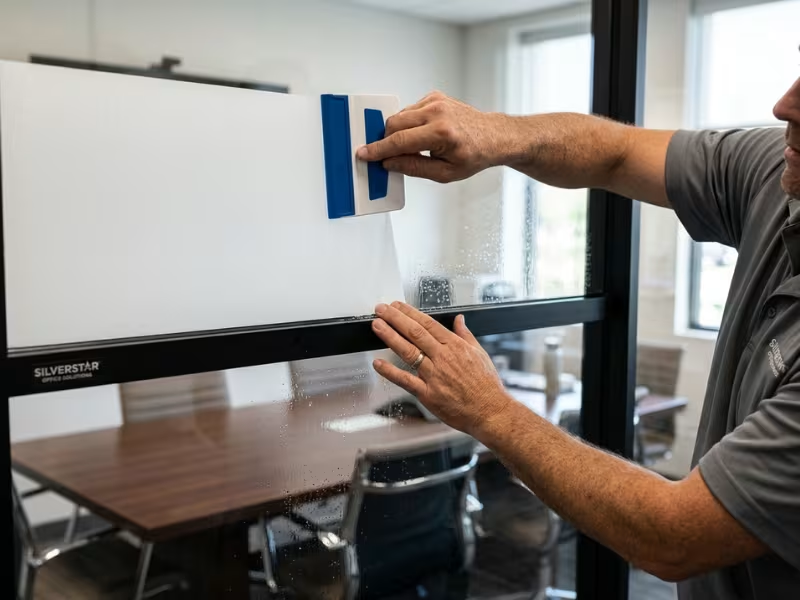
Film is where I start for most clients. An installer applies it to the glass on site, so you can add it to new or existing partitions. Changing the band height or swapping in a new logo takes an afternoon, not a glass order.
It also suits leased space. At move-out, the film comes off and the glass returns to clear, which keeps you on good terms with your landlord’s restoration clause.
Quality matters more than price here. A good architectural film typically lasts about 7 to 10 years indoors. Cheap film can yellow, bubble, or lift at the edges within two. Ask your supplier for the brand, the warranty term, and whether the price includes edge sealing.
One tip: apply film to the inside face of the room where you can. Fewer passersby will brush against it or catch the edges with carts.
Acid-Etched Glass: Permanent and Polished
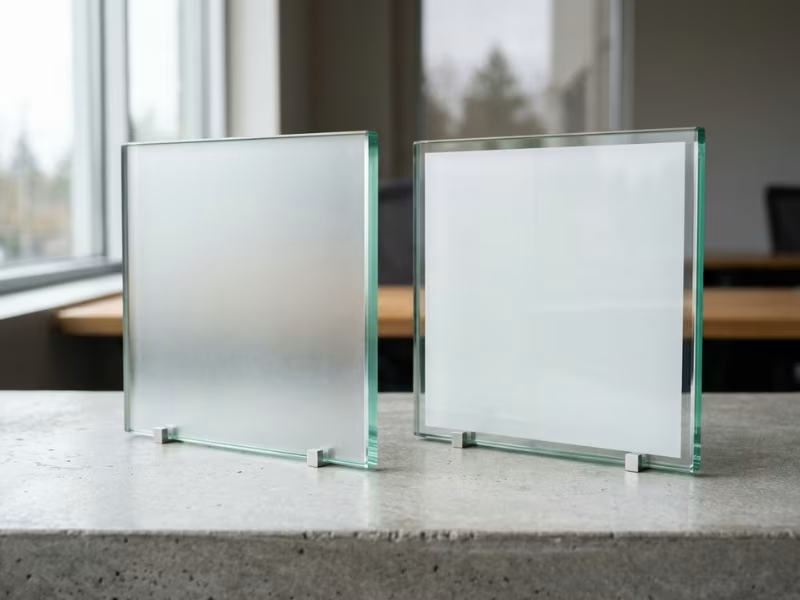
Acid etching treats the glass surface itself. The frost becomes part of the panel, so it can’t peel, bubble, or fade. The finish looks smoother and more even than film, which is why clients choose it for executive floors and reception walls.
The trade-off is commitment. Once you etch the glass, the design stays. If your layout or branding changes, you replace the whole panel. I recommend it when you own the building or sign a lease of ten years or more.
Expect it to cost more than film, and plan it early. Your supplier must etch the glass before it ships, so the frost pattern has to be final at the drawing stage. Also, ask which side faces out. The etched face picks up fingerprints and grease, so most installers place it on the side people touch less.
Smart Glass: Privacy on Demand
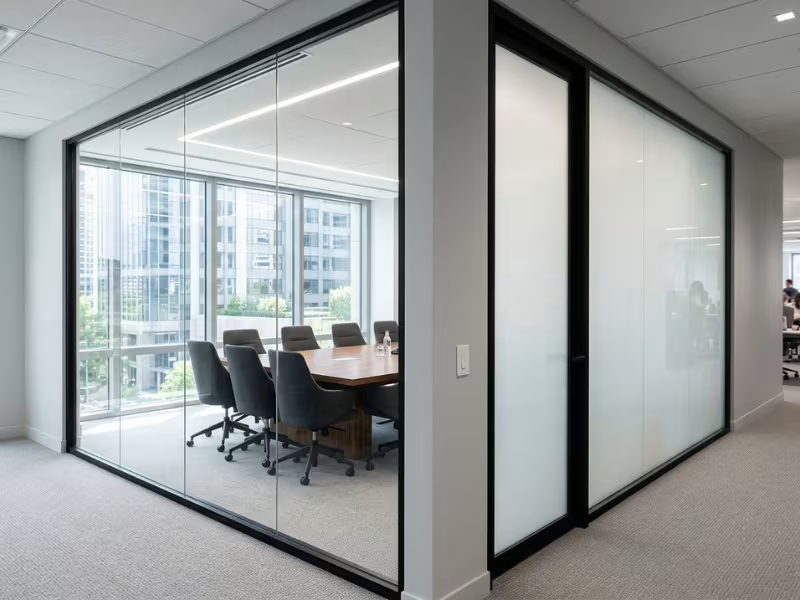
Smart glass uses a PDLC layer between two panes. With power on, the glass turns clear. With power off, it turns frosted. Most systems default to frosted when the power cuts, which works well for privacy.
It solves a real problem in rooms that change roles during the day. A boardroom can stay open for a team meeting, then go private for a board vote. A clinic room can switch to frosted during an exam.
But it often costs several times more than film or etched glass. Every panel needs wiring through the frame, a power supply, and a switch or control system. Bring your electrician in before the shop drawings go final. Even in clear mode, the glass carries a slight haze. Some clients notice it in rooms with strong daylight.
I limit smart glass to one or two rooms where switching truly matters. Using it across a whole floor rarely pays back.
How I Usually Split the Budget
On most projects, I mix all three. Film covers meeting rooms and support areas, where needs change often. Etched glass goes where the finish must look premium for years. Smart glass stays in the one room that genuinely needs to flip between open and private.
That mix keeps the budget in check and still gives every room the right finish.
Design Details That Change the Result
The frost style sets the direction. The details decide whether the room looks right and works on day one. I check five of them on every drawing before it reaches the client.
Band height. Measure it in the real room. Sit in the actual chair at the actual table, and mark where your eyes land. Then have someone stand outside at normal walking distance and note what they can still see. Most seated eye lines fall between about 1,100 and 1,250 mm, but a raised floor or tall chairs can shift that. Set the band to cover the seated eye line with roughly 150 mm to spare above and below.
Frame style. Slim frames, around 40 to 50 mm wide, let the band run like one clean line along the wall. Bulky mullions chop it into short blocks, and the wall starts to look busy. If you have heavy frames, widen the band slightly so it holds its own against them.
The door. This is where many projects fall apart. If the band stops at the door, the line breaks right at the busiest spot. Match the band height on the door glass exactly. Also, check that handles and closers sit outside the frost zone, or they’ll look like an afterthought.
Branding. It works best in small doses. A logo or pattern at reception or the main entrance adds identity. Repeat it on every meeting room, and the floor turns into a billboard. Keep logos inside the band, and make sure they don’t leave clear gaps at seated eye level.
Low-iron glass. It matters when the frost needs to look crisp. Standard glass carries a green tint that turns white frost slightly gray-green, especially at the edges. Low-iron glass keeps the frost bright and clean. I use it on reception walls and executive suites, where people look closely.
Common Mistakes and Buyer Concerns
Before clients sign off on frosted glass, most raise the same five worries. Some are fair. One is a costly myth. Here’s how I answer each.
“Frosted glass will make the office feel closed off.” It only does that when you frost too much. A mid-band or gradient hides seated people and leaves the upper glass clear. Daylight, ceiling lines, and movement still carry across the floor. Rooms feel boxed in when buyers frost every panel from floor to ceiling “just to be safe.”
“The film will bubble or peel.” Cheap film and rushed installs cause that, not film itself. Good architectural film typically lasts 7 to 10 years indoors. Ask for a trained installer, spotless glass, and sealed edges. Then hold off on heavy cleaning for a few weeks so the adhesive can cure. Tiny bubbles in the first days usually dry out on their own.
“It will darken the room.” Frosted glass scatters light instead of blocking it. Most etched glass and quality films still pass roughly 70 to 85% of visible light. Rooms often feel softer, with less glare on screens. If you need every bit of daylight, keep the frost to a band and leave the rest clear.
“If people can’t see in, they can’t hear in.” I correct this mistake more than any other. Frost changes the surface of the glass, not its mass or its seals. A frosted pane leaks speech just as easily as a clear one. If a room hosts HR talks, client calls, or medical consultations, set an acoustic target on its own. That means laminated or double glazing, tight gaskets, and a sealed door. For quick one-person calls on an open floor, office phone booths can solve speech privacy without building another enclosed room.
“Let’s put our logo everywhere.” Branding loses impact when it covers every wall. Dense patterns also cut light and make the floor feel busy. Save large graphics for reception or the main entrance. Elsewhere, use a simple band with a small logo inside it.
When frosted glass disappoints, the cause usually comes down to two things: too much coverage, or the wrong expectations.
A Simple Way to Choose the Right Frosted Glass Option
When a client hands me a floor plan, I don’t start with samples or swatches. I work through six steps, room by room. On a typical floor, this takes about an hour, and it stops most bad choices before they reach a quote.
- Identify who needs visual privacy. Ask who sits inside the room and who walks past it. A manager on budget calls needs cover from corridor traffic. A visitor in an HR meeting needs cover from everyone. A print room only needs to hide clutter. Write one line for each room: “Hide ___ from ___.”
- Check seated and standing sightlines. Sit in the real chair at the real table. Then have a colleague walk past outside at normal distance. Mark where your eye line meets the glass, and note what a standing person can still see. Now you have a band height in millimeters instead of a guess.
- Choose static or changeable privacy. If a room keeps the same role all day, static frost works fine. If it switches between open team sessions and confidential talks, consider smart glass. Most floors need it in one room at most.
- Match the finish to lease length and budget. On a short lease, or if your branding may change, choose film. On owned space or a lease of ten years or more, acid-etched glass pays back in durability and a cleaner finish. Put premium finishes where visitors look closely, and use film everywhere else.
- Check acoustic needs separately. Go back to your room list and add a second line: does anyone outside need to not hear? Frost won’t help with that. Rooms for HR, legal, or client calls need laminated or double glazing and a sealed door. Price those upgrades as their own line item.
- Shortlist one or two options before requesting quotes. Pick a frost style, band height, and finish for each room type. Send the same marked-up plan to every supplier. Three suppliers quoting one spec gives you a fair comparison. Ten loose ideas give you ten prices you can’t compare.
Follow these steps in order, and every frosted panel on your floor will have a clear job to do.
Maintenance, Updates, and Long-Term Use
Each finish ages differently. Choose one your facilities team can realistically look after.
Cleaning. Use a soft microfiber cloth and a mild, ammonia-free glass cleaner. Skip scrapers, abrasive pads, and razor blades. On film, wipe toward the edges, not against them, so the corners don’t lift. Etched glass only needs a damp cloth to clear fingerprints.
Film lifespan. Quality architectural film usually lasts about 7 to 10 years indoors. Watch for lifting edges, yellowing, or cloudy patches near busy doors. Any of these means the film needs replacing.
Updates and rebranding. Film peels off cleanly, and an installer can apply new film the same day. A typical meeting room takes a few hours, so you can book the work after hours.
Acid-etched glass. The frost lasts as long as the glass. But if your layout or logo changes, you replace the whole panel, not just the finish.
Smart glass. Ask an electrician to check the wiring, connectors, and switches once a year. Clean with a soft, lightly dampened cloth. Never spray liquid at the panel edges, because moisture there can damage the PDLC layer. If a panel stops switching, check the power supply and controller first. If those work, the panel likely needs supplier repair or replacement.
Decide who will maintain each finish before you choose it. That one decision saves money for years.
Start With Sightlines, Then Choose the Frost
Frosted glass works best when every band has a reason to be there. So don’t choose by style alone. Start with who needs cover, from whom, and at what height.
Match each room to its privacy level. Use full frost where being seen is the problem, mid-bands where people need cover only when seated, and soft patterns where you just want to blur detail. Then pick film, etched glass, or smart glass based on lease length and how often the room changes roles.
Treat visual and acoustic privacy as two separate jobs. Before you request quotes, check seat heights and sightlines in the real rooms, and shortlist one or two options per room type.